



Jebel Ali Mile (G3) Sponsored by A.R.M. Holding
Thrilling. That’s the only word to describe the driving finish of the 2026 running of the Jebel Ali mile on Sunday. Three horses separated by just 0.03s at the line. In the end, the race was called to be a dead-heat between David of Athens and Masmak, but the connections of Mount Kosciuzsko may well feel that he was the slightly unlucky loser given that he had the fastest late speed figure of the trio.
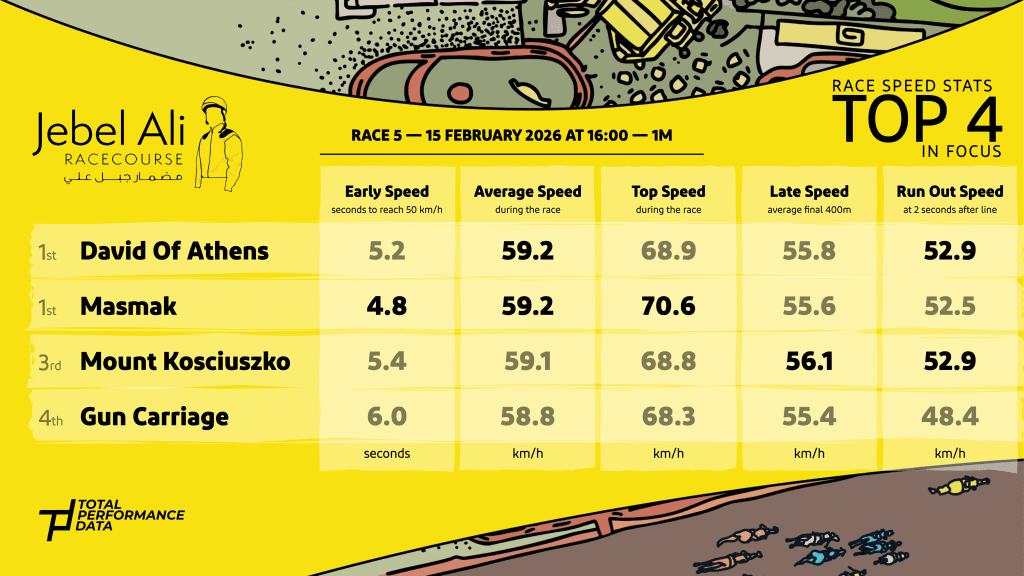
I’ll begin with Masmak. At an average of 24.38 ft, he had the shortest stride length of the 3 and having raced prominently under Bernardo Pinheiro, he had the better of their racing positions. However, having been drawn wide in stall 12, Masmak did have to work hard in the early stages to get across to lead and having responded readily to the early encouragement from his rider to do so, the fact that he was still in contention as they began to climb the Jebel Ali hill is testament to his attitude. Having switched from the US last year, he seemed to find the jebel Ali track more to his liking than the bends at Meydan. On another day, he may have won the race outright and although he did get the first run for the line, he had to work very hard in the early stages to get that privilege. With a race best top speed figure of 43.85 mph, he was the fastest horse in the field and if getting a better draw next time, there is every chance that he might have too much speed for his rivals.
David of Athens had the harder task. At an average of 24.91 ft he had the longest stride in the field and for such a big horse, it was perhaps not surprising to see that he struggled to maintain his position around the turn. Initially caught 4 wide, he leaned in to his right before then swinging wide and lost as much as 4 or 5 lengths in that time. Once straightened for home, James Doyle allowed him to balance himself before driving him through on the inside of Masmak to make his challenge. He was faster than Masmak in the closing stages, recording a late speed figure of 55.8 km/h and running the fastest final furlong to get his head down on the line to dead-heat for this Group 3 prize. He ran a very similar race when winning the trial for this race in January, rattling home with a late speed figure of 34.32 mph and a final furlong of 13.78s. He is clearly well suited by the stiff finish at Jebel Ali, but with such a long stride, there is always the chance that the tight bend will leave him with a lot of work to do. Having run so well here, he may well be considered to be a better horse at Jebel Ali, but the long straight at Meydan should also suit and it’s not impossible to think that he could translate this form if getting into a prominent position over further.
Mount Kosciuzsko was further back than ideal on the inside rail and having been forced to switch wide to get racing room, he lost momentum at such a crucial stage that his closing effort can definitely be upgraded. Silvestre de Sousa had to work hard to get him into contention and having been the fastest horse in the penultimate furlong, he is perhaps the horse to take from this race, although his overall record does race some doubts about his ability to get over the line in front.
If this race were to be run again there is every chance that we would get a different result. With less than a foot between all 3 of their average stride lengths, less than 0.3 mph between their late speed figures and a difference of just 0.04 per second between their average stride frequency figures, it is fair to say that there is as little between David of Athens, Masmak and Mount Kosciuszko as the photo finish might suggest. A close examination of the data from TPD would suggest that they have all overcome adversity to be involved in a thrilling finish and that under different circumstances, they may all be capable of winning next time.