



WATERSHIP DOWN TOO DARN HOT GREENHAM STAKES (G3)
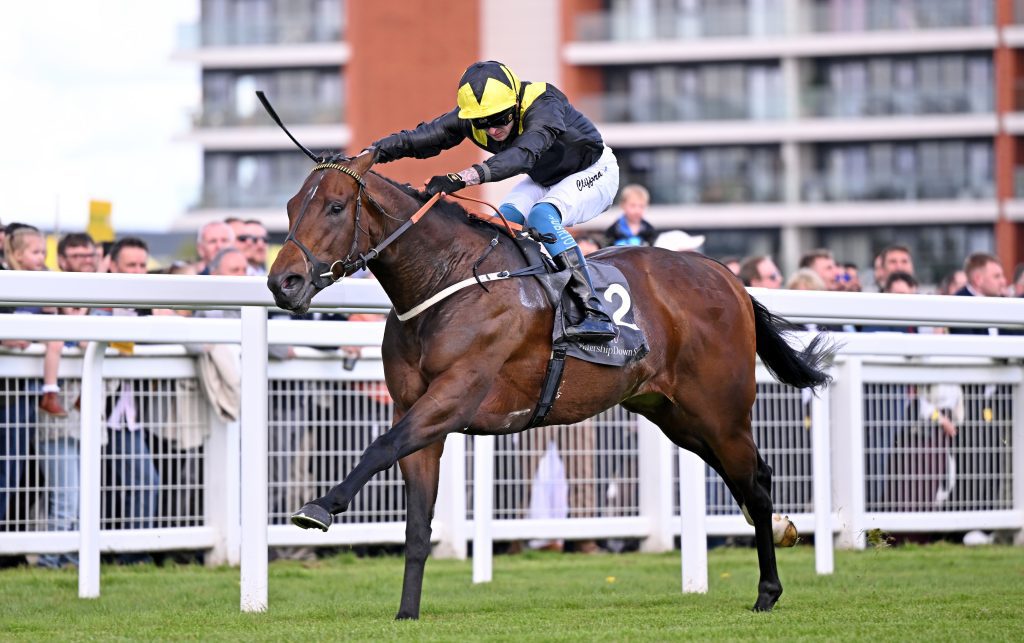
The Dewhurst form did take a boost in this year’s running of the Greenham Stakes at Newbury, but not necessarily in the manner that might have been expected. ALPARSLAN was only 6th behind Gewan at Newmarket in October, but he made a significantly greater impact on his seasonal return to win the Greenham Stakes as he held off the late challenges of Zavateri and Albert Einstein to win by a length. There are reasons to explain this victory from the data, but before we get into the semantics of the Greenham Stakes, I think it is important to recognise that the winning time of 1:24.92 was under the TPD expected time for the race, although they were 0.10s slower than Sukanya in the Fred Darling Stakes over the same course and distance 35 minutes earlier. The ground, officially described as “Good, Good to Firm in places” played a part in that time figure and this year’s race ranked 4th in the last 10 years. This was a fair time for a Guineas trial, but no more than that and that level of pace does help to explain the result.
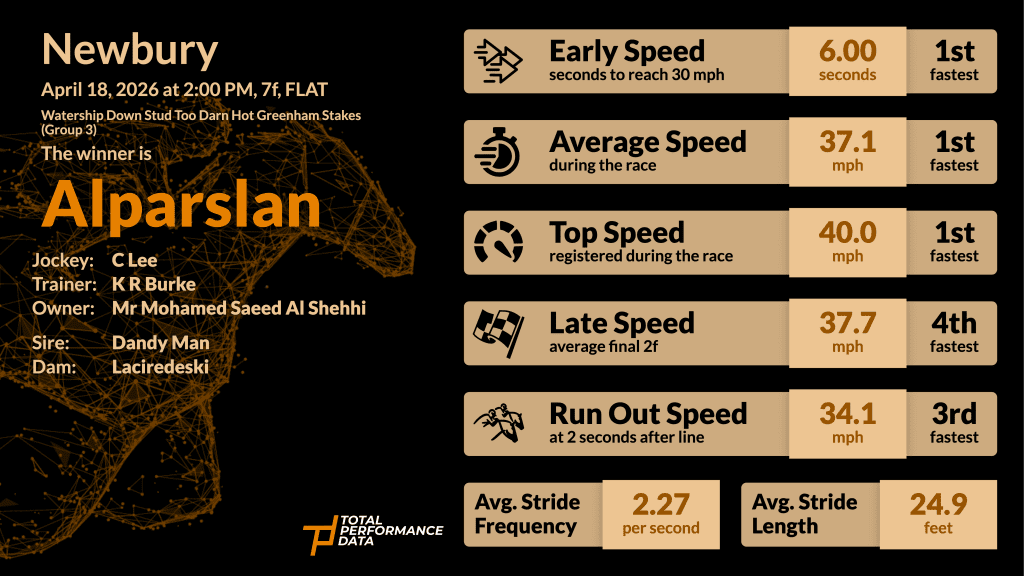
The draw and in particular the winner’s track position played a key part in this result. If you watched the racing at Newbury on Friday, it would have become clear that there appeared to be an advantage to horses that came towards the stands side of the course. The winners on the straight course on Friday came from stalls 10, 8, 10 and 4. The Fred Darling winner did slightly buck that trend, but the later winners on Saturday came from stalls 20 and 15 and both of them were close to the stands side rail. As a result, being drawn closest to the rail was a clear advantage for Alparslan, who ran the fastest opening furlong in the field (14.84s) when the gates opened, reaching 30 mph in 6s. That opening furlong was the only time in the contest where Alparslan ran the fastest split in the field and that allowed him to get into a prominent position and left him in the ideal place as the field began to tack across towards the rail. At a peak average of 25.90 ft, Alparslan had the longest stride in the field when fully lengthened and having had the advantage of setting even fractions, recording a finishing speed of 102.5% and having had the run of the race on the best part of the track, he was always likely to prove to be hard to pass. I don’t want to detract from what was a very good performance by the winner. Alparslan had the highest top speed in the field (40.01 mph) and won by a length, galloping through the line with a run-out speed that was quicker than the 2nd and 3rd. However, the point I do want to make is that this race was set up perfectly for Karl Burke’s charge and a couple of the horses in behind him may well have connections looking forward to their chance to have another go.
The first question for me is whether Zavateri or Albert Einstein really stayed the trip. Zavateri was having his first run of the season and having traveled behind the pace, he looked like he was coming to make a serious challenge when he clocked 11.43s for the penultimate furlong to get within a length of the leader. His average stride frequency reached its peak of 2.43 strides per second at that point and he was faster than the winner over the final quarter of a mile. However, his stride frequency dropped in the closing stages to 2.28 per second, a much bigger drop than the winner, whose average fell from 2.22 per second in furlong 6 to 2.18 per second in the last. Both were having their first run of the season and will clearly have been using this race to get them ready for the Guineas, but if Zavateri were to be behind Alparslan in 2 weeks time, he will once again be chasing a horse with a longer stride who hit the line well and that won’t be an easy task.
Albert Einstein had the benefit of a run in the Gladness Stakes on his side, so the race fitness excuse can’t really be used with him. He also recorded a time of 11.43s for the penultimate furlong, but overall he was still slightly slower than the winner over the final quarter of a mile and he didn’t seem able to sustain his challenge. I’m not going to put into writing that he can’t win a Guineas and Aidan O’Brien should not be doubted given all that he has achieved. What I will say is that Albert Einstein will not be able to make all to win a Guineas. On the evidence we have so far, he has a turn-of-foot, but will need to be played very late to get the best use out of that and with the undulations of Newmarket, that could be a difficult task.
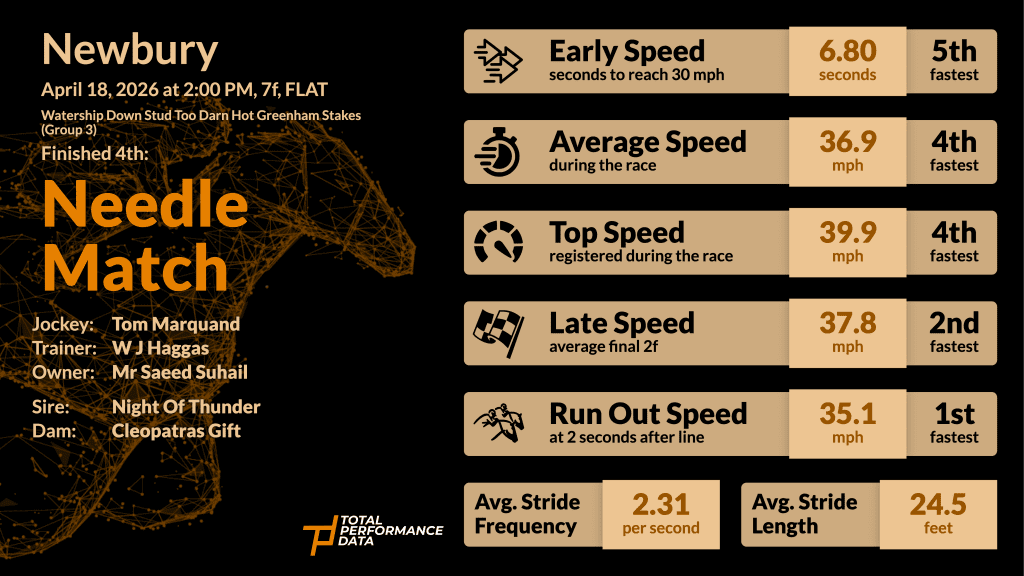
The horse that I really want to take out of this race is the 4th placed Needle Match, trained by William Haggas. Having raced further from the rail, I thought he ran a fine race on what was just his 2nd start and the data that TPD recorded for him in the latter part of the race would offer plenty of hope that there is more to come from this Night of Thunder colt. The first point is that he ran the fastest final furlong in the field in 12.08s. His run-out speed of 35.10 mph was also a race best figure and more than 3.5% quicker than the horses that finished 2nd and 3rd. All of that came despite the fact that he raced further from the stands side rail and having been last after the opening quarter of a mile, I think this was a superb effort to finish within 2.5 lengths of the winner. Both his starts to date have come at Newbury and the form of his debut win in October is average at best, but taking that into account I think this was a brilliant effort and if building on this, he should be more than capable of being a 100+ horse this season.