



What does it take to win an Ascot Gold Cup?
The number of races run over the Ascot Gold Cup trip can be counted on one hand. When a horse runs in the showpiece race at the Royal meeting for the first time, they are galloping into the unknown once they pass the 2 mile pole. It is an elite test of stamina and as all the great trainers to have won it have said, “you never really know until they go beyond 2 miles”. So which attributes should we be looking out for in this year’s Ascot Gold Cup? I’m going to start with a look at the races over the extended 1 mile and 7 furlong trip and beyond since 2022. The graphic below shows the top 10 average speed figures recorded by horses in those races. Trawlerman came out on top from his win in last year’s Gold Cup, run on good to firm ground. That’s not surprising. His winning time of 4:15.02 was fast, 5s quicker than the TPD expected time for the course and distance and easily the fastest winning time since the turn of the century. In fact, you have to go all the way back to Sadeem’s win for Guy Harwood under Willie Carson in 1988 to find a horse who recorded a time with a second of Trawlerman. That average speed figure helps to explain last year’s result and why the field was strung out at such large intervals as they came around the home turn. There was no hiding place in the 2025 Gold Cup and it found out any horse with stamina doubts.
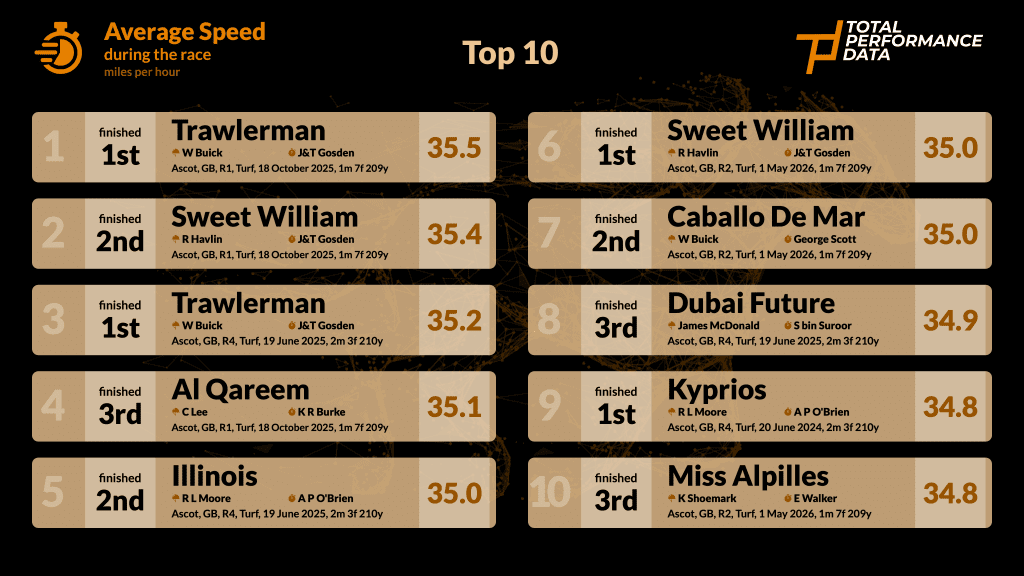
Trawlerman’s figure is a slight outlier and our expected average for a winner would be closer to the 34.8 mph recorded by Kyprios in 2024. If we take that as a hypothesis for the pace, assuming that the ground is somewhere in the region of Good/Good to Firm next week, then it may help to be the first pointer towards horses who are able to maintain that gallop. Scandinavia has achieved that metric. He recorded an average speed of 35.4 mph on soft ground when winning the St Leger at Doncaster, as well as an identical figure when 5th in the Queen’s Vase at the Royal meeting last Summer. We know Trawlerman can do it, so can Caballo De Mar who recorded an average speed of 35 mph when 2nd to Sweet William in the Sagaro Stakes in early May. Rahiebb has also recorded average speed figures above the 34.8 mph line when finishing 2nd in last year’s St Leger, but it is not as straightforward as just recording an average speed figure like that. If it were, Sweet William may well have won a Group 1 by now. Having the stamina for these marathon tests is one thing, but these races also require a finishing kick and the need for a high late speed figure is perhaps a better test of what’s required. It’s not enough to simply stay the distance, it’s about the conservation of energy to be able to respond to the jockey when the horse turns for home that sorts the champions from the also-rans.
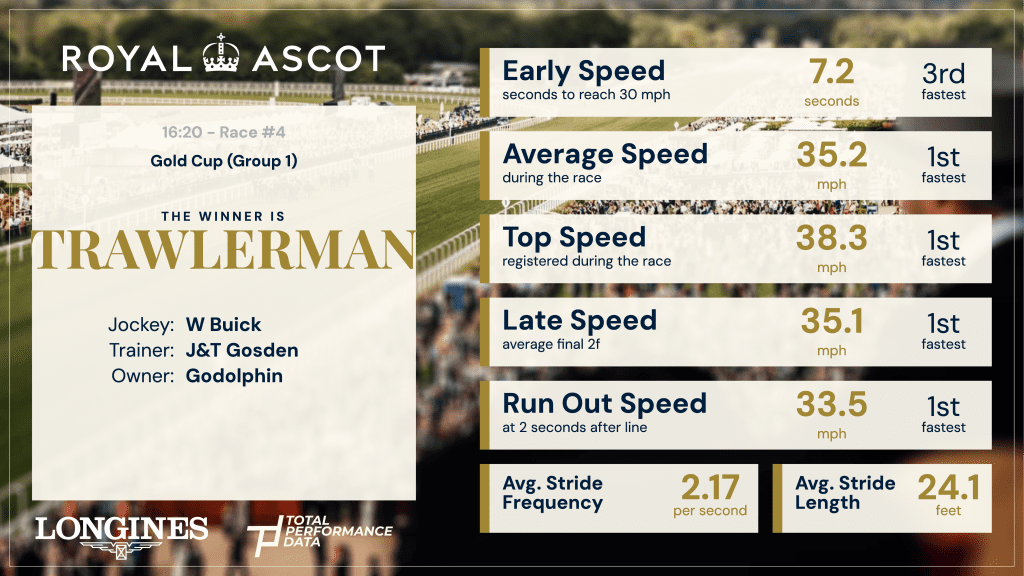
Above is a look at the data that TPD collected for Trawlerman when he won this race 12-months ago. It is no coincidence that he ranked 1st for all of the major speed metrics, especially given both the mid-race pace and the way he quickened in the latter stages. He ran the fastest final 2 furlong splits in the field under William Buick (12.64, 12.81s) but he had something left in the tank for the climb up to the line. His average stride frequency dropped from 2.21 in the penultimate furlong to 2.18 strides per second in the last, a fall of 0.03. That was the smallest decrease in the field, with the exception of the tailed off Yashin who was coasting home at 1.77 strides per second. Those stride frequency figures, combined with his race best run-out speed prove that he won the race with both stamina and late speed. Trawlerman recorded similar stride frequency figures in the final furlong of the 2024 Gold Cup, but Kyprios was simply too strong. The pair of them have won 3 of the last 4 renewals of this race and the fact that both of them recorded minimum stride frequency averages of 2.09 strides per second in the last 2 years is the key to explaining why. They both relaxed in the middle part of their races. Courage Mon Ami won in 2023 with a minimum stride frequency average of 2.15 per second, but he was held up towards the rear by Frankie Dettori and played much later. The presence of Trawlerman, Scandinavia, Sweet William and Rahiebb in this year’s race would suggest that this will still be a typical stamina sapping test.
So can Trawlerman win the race again? If he arrives in the same form that he showed last season then of course he can. However, we are yet to see him this season and that would look to put the statistics against him. In the last 10 years, all of the 10 winners had run within the last 100 days and according to At The Races, you have to go all the way back to the first of Yeats 4 wins in the race in 2006 to find a winner who was having their first run of the season. It is one thing to train a horse at home for a race, but it is quite another to do so for one of the most difficult tests that racing offers to the thoroughbred. The Gosden team will deserve all the plaudits imaginable if they pull it off.
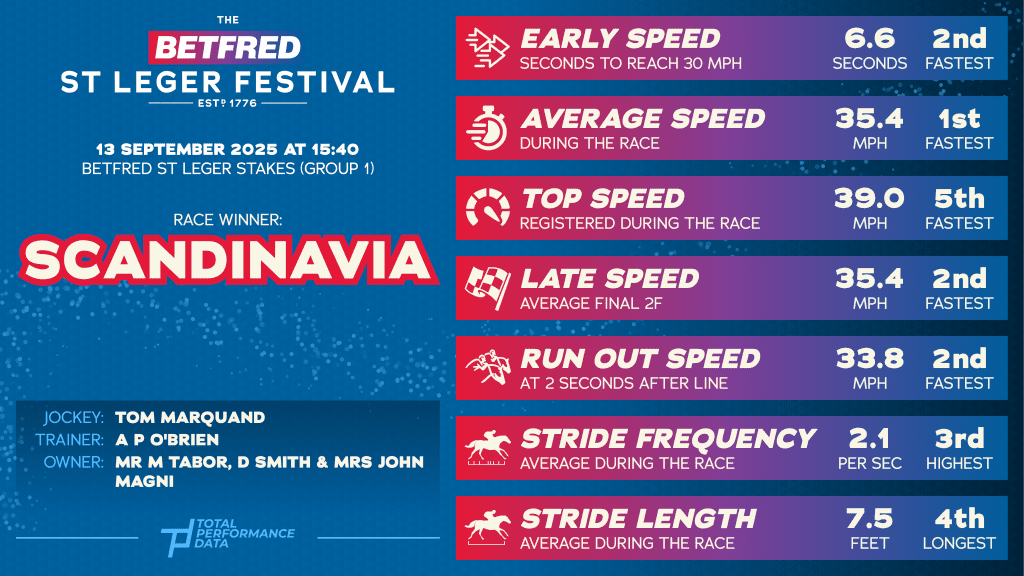
What about this year’s favourite Scandinavia? Does he fit the bill for a potential Gold Cup winner? He has followed a tried and tested route used by Aidan O’Brien in recent years and has won both starts to date in Ireland. He should stay and he got his stride frequency as low as 2.1 per second in the Queen’s Vase last season over the shorter distance, as well as getting down to 2.02 per second in the Goodwood Cup, so we can be fairly sure he can relax in the middle part of the race too. We can’t really be sure about his stamina because he has never gone beyond the 2 mile distance and although he is unbeaten since running at Ascot last season, in 2 of the last 3 races there have been rivals who have run faster final furlongs. He clearly ticks the trainer and jockey boxes and having won a Goodwood Cup as a 3-year-old, the chances are that this distance will be fine. I’d make him favourite if I were pricing the race, but the gaps between Scandinavia and Rahiebb are minimal when we look at the data on the TPD database.
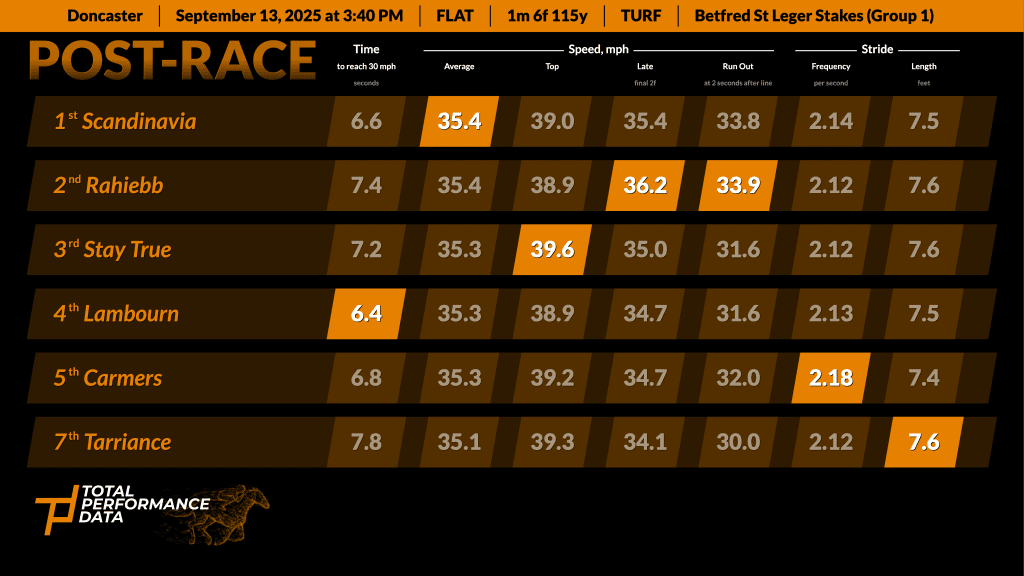
The first point to make is that Rahiebb finished ahead of Scandinavia in the Queen’s Vase. He also had a better late speed figure when finishing as the runner-up in the St Leger at Doncaster (see above) when he ran the fastest final 2 furlong splits in the field. When making allowances for the fact that he raced towards the far side rail and conceded first run to the Ballydoyle runners, it was a huge performance. He had the best run-out speed in the field and there was just 0.05s between the pair when they crossed the line at Doncaster. I was suitably impressed by his victory in the Yorkshire Cup in May too. Admittedly the pace was a sedate one and he rattled home with a finishing speed of 109.7%, but he quickened well in the straight to get himself on terms and ultimately ran out a relatively comfortable winner. That was over the 1 mile and 6 furlong trip and so he does have the stamina questions to answer, but I did at least think it was on a par with the 2026 performances of Scandinavia at Navan and Leopardstown.
This year’s Gold Cup is a very difficult puzzle to try to solve. We haven’t seen the reigning champion in 2026 and the statistics would suggest that the absence should be a concern. If not Trawlerman, then the market has this race between Scandinavia and Rahiebb. Neither of them have run at this extreme distance before and whilst they should stay, we can’t be sure until they actually have. Caballo de Mar has won a Group 1 over 2 miles this season, but the Prix Vicomtesse Vigier turned into a sprint with a finishing speed of 111%, so it’s hard to be certain that he will stay and Sweet William has had his chances at this level before. Dubai Future was 3rd in the race last season and arrives here in winning form, but he was ridden to be 3rd last season when James McDonald gave him one of the rides of the meeting and if he filled the same spot again, I’m sure that his connections would be delighted with him at the grand age of 10.
The percentage call is to focus on the 4-year-olds. They have won this race 11 times since the turn of the century and the likelihood is that they are still improving. I can completely understand why Scandinavia is the current favourite, but I also can’t get that St Leger out of my head. The data suggests that Rahiebb was finishing the stronger and with another 10 yards, he would have won and there was just 0.02 mph between their top speed figures on the day. He ran a superb race to win the Yorkshire Cup on his return and whilst I am taking his stamina on trust, his run-out speed data does suggest that he has as good a chance as any of getting home. All the time there is such a margin between their 2 prices, I think Roger Varian’s charge is the one to be with.