



Royal Ascot 2026
The 2-Year-Old Review
I certainly wasn’t short of material when it came to choosing a topic for this week’s column for TPD. Royal Ascot was fantastic and 35 highly competitive races presented a wealth of data that could be used to create some interesting angles. Scandinavia and Trawlerman producing a Gold Cup to remember (though maybe they weren’t quite as good as Kyprios), Ombudsman confirming his place amongst the world’s elite racehorses, Bow Echo getting the better of Gstaad, Bacio flying along the stands rail on Friday evening to put Wesley Ward back in the Ascot winners enclosure, the list was almost endless. Each of those races deserve some column inches, but I felt that it was the 2-year-old races where the data could be used to best effect to add some context to the performances that we saw on the track.
Coventry Stakes (G2) – 16th June
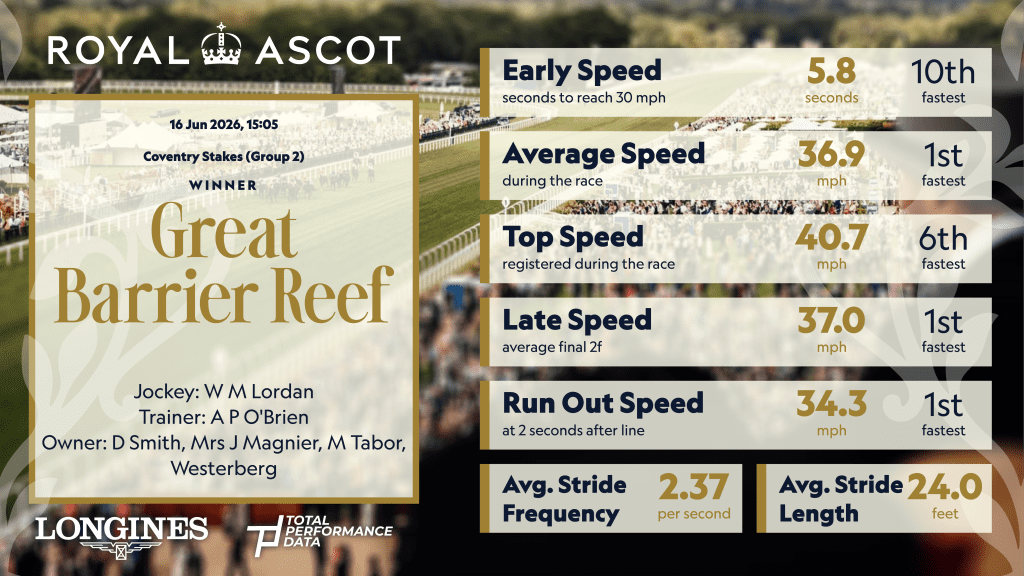
I had to start this piece with a look at GREAT BARRIER REEF for Aidan O’Brien because having watched every race a couple of times, I have reached the conclusion that he was the best 2-year-old on show this week. That’s perhaps seen as a slightly bold statement but I think I can make a very strong case from the data. Firstly, being drawn in stall 3 made his task all the more difficult. Having initially raced in the far side group, he was nearly half a second behind the leader (Jaan Ki Tukri) at the halfway point. If we take just the runners in that far side group, he has beaten them by a distance, with Treasurer (12th) the next to cross the line, 1.52s after Great Barrier Reef, beaten almost 9 lengths. He ran the fastest final furlong in the field in 12.31s, which is perhaps not that surprising given that he won the race, but he had the fastest late speed figure in the field at 37 mph and that figure was significantly faster than the 35.4 mph recorded for Treasurer over the same part of the track. Having moved across the track under Wayne Lordan, he was travelling best of all at the 2 furlong pole and despite the fact that 4 of his rivals ran quicker penultimate furlongs on the fastest part of the track, Great Barrier Reef still pulled out more in the final furlong to ultimately win going away. A run-out speed of 34.3 mph, measured 2s after he crossed the finish line, would suggest that he had plenty left in the tank and I’d suggest that he was probably value for much more than a winning margin of half a length would suggest. His average stride frequency figures were above his overall race average in furlongs 4 and 5, the point at which he was making his challenge and all of this was achieved despite racing furthest from what appeared to be the best of the ground by the stands side rail. No Nay Never has already bucked a trend this year by having the winner of the 1,000 Guineas at Newmarket (True Love) and he sired the winner of both the Coventry and the Albany Stakes this year, both of which look capable of further improvement by stepping up to 7 furlongs. The form book will show a win by half a length, but the data would suggest that this is a top-class performer who has overcome the track bias to remain unbeaten and when we discuss the value of the Coventry Stakes form at the end of the season, I will be shocked if Great Barrier Reef hasn’t proved to be the best horse on show.
Windsor Castle Stakes (Listed) – 17th June
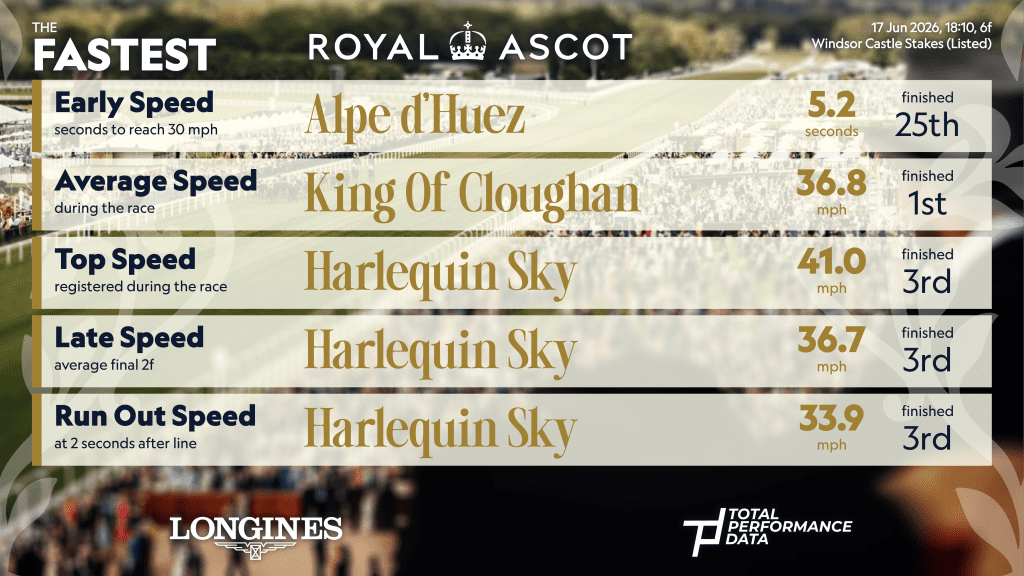
When the first 4 horses to cross the line return SPs of 33/1, 66/1, 125/1 and 28/1, there would be a tendency to dismiss this form as somewhat suspect. I certainly think that the winner was drawn on the right side of the track and the performances of Sale Shark (5th) and Dorigo (7th) can be upgraded given how hard they had to work in the smaller far side group to remain competitive. However, the first 3 crossed the line over 2 lengths clear of the rest and I don’t think that the closing data recorded by the winner, KING OF CLOUGHLAN, should be entirely put down to being on the right side of the course. It was a very good week for Joseph O’Brien and this son of St Mark’s Basilica may not grab the same headlines as some of the stable’s other winners, but in his own way he was very impressive. Having been behind the early lead, he made smooth headway and showed a good turn-of-foot to get himself on terms, despite the fact that his top speed figure of 39.99 mph was slower than the top speed figures of the next 6 horses to chase him home. He lengthens nicely in the middle part of the contest, reaching a peak average stride length of 24.57 ft and once in front, he found plenty, coming home with a race best time of 12.35s for the final furlong. I thought his performance was very striking, but if I like King of Cloughlan, then I also have to add the 3rd placed HARLEQUIN SKY to the notebook. Jane Chapple-Hyam’s filly remains a maiden after 3 starts, but as the data above would suggest, she was slightly unfortunate to remain so after this performance and it surely just a matter of time before this daughter of Dubawi Legend wins a race. This race had a finishing speed of 98.7%, so she was perhaps in the right place towards the rear of the field in the early stages, but having been forced to make her challenge towards the centre of the course, it was still a remarkable effort to get as close as she did and she was the fastest horse in the field for furlongs 4 and 5. A run-out speed of 33.87 mph, also a “race best” figure, suggested that she had something left after crossing the line and she was 0.44s quicker than the winner when we examine the final 3 furlongs overall. At an average of 23.20 ft, she had one of the smaller strides in the field, but she finished really nicely and ought to be more than capable of making her mark later in the year.
Chesham Stakes (Listed) – 18th June
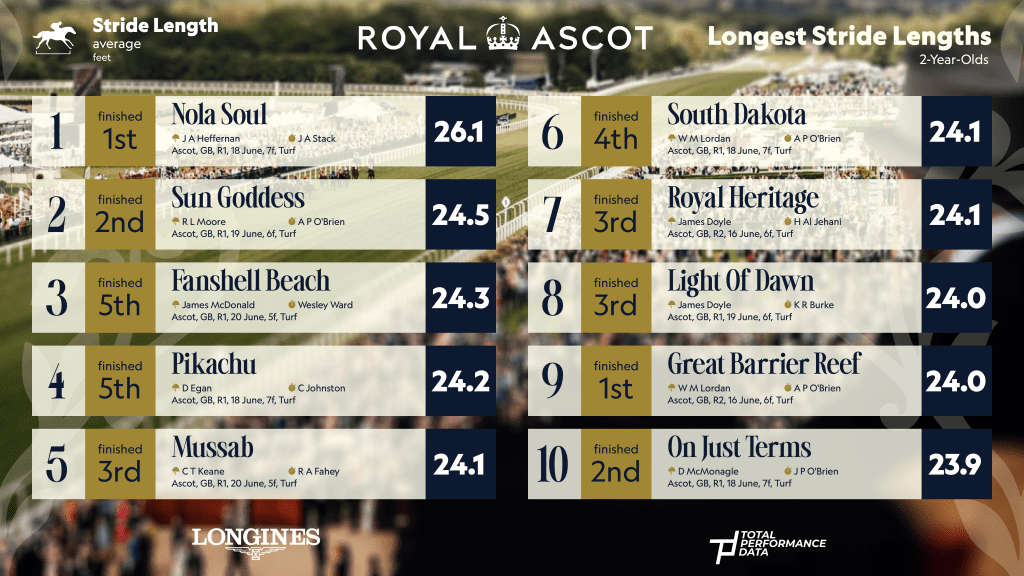
NOLA SOUL. I’m not even sure where to start with this son of Justify. He won a Chesham Stakes despite the fact that he didn’t run a fastest furlong split at any point of the contest and his in-race speed metrics ranked 7th (top speed), 2nd (late speed) and 5th (run-out speed). He was the beneficiary of a superb piece of pace judgement by Seamie Heffernan who managed to hold on to his mount in the opening 2 furlongs, despite the fact that Nola Soul was pulling hard and refusing to settle. Whether by design or jus by coincidence, he ended up in front as they passed the 3 furlong pole and having been so keen, at first glance it was a bit of a shock to see how much he continued to find. Nola Soul has an incredibly long stride. I actually asked our data team to double check the figure to make sure that it was correct. At 26.1 ft, Nola Soul had the longest average stride length of any 2-year-old running at Ascot this week. That’s remarkable enough and as you can see from our stride length graphic above, he dwarfs most of the leading juveniles this week. Even more remarkably, this is the longest average stride length that we have recorded for any horse running at this year’s Royal Ascot. If we get technical about it, for which I will switch to metres to make it easier. Nola Soul recorded an average stride length of 7.83m in the penultimate furlong at an average of 2.11 strides per second. That means that every second he was covering approximately 16.52m. By comparison, the runner-up (On Just Terms) recorded averages of 7.08m at 2.34 strides per second in the same furlong to cover 16.56m. That’s a difference of 4cm, but it required On Just Terms to take an extra stride once every 4s just to stay on terms with Nola Soul. For such a big colt to be capable of winning a 7 furlong race at Royal Ascot as a 2-year-old can only be seen as a positive for his future and it probably goes without saying that as he grows and develops into his frame he could be capable of being even better.
Albany Stakes (G3) – 19th June
There is every chance that Sun Goddess is going to be a superstar filly for Aidan O’Brien. Having been supported into an SP of 10/11, she was clearly thought to be in that category already and she appeared to do very little wrong. Her average stride length of 24.55 ft was significantly higher than the average figure we have for a course and distance winner and having sat behind the early leader, she appeared to be travelling very comfortably as they passed the halfway point in the race. Having been brought to the front to make her challenge, she conceded the better ground to those racing closer to the stands rail and still finished over a length ahead of them. I think she has a lot of potential to be a top class filly and lost very little in defeat given the way this race panned out, but if that is the case, then it can only add to the reputation of LIBERTANGO.
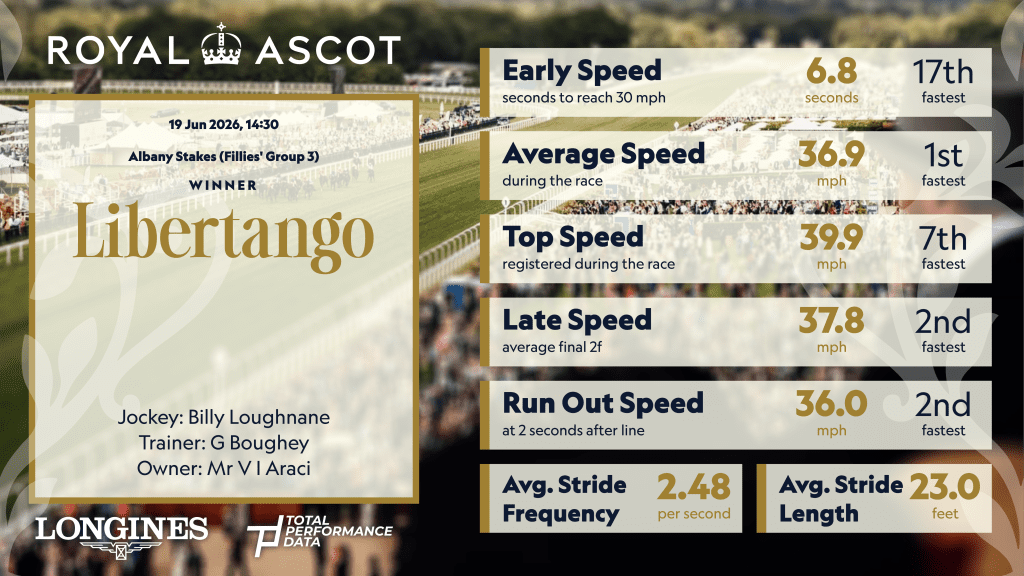
George Boughey’s charge overcame a low draw by being switched behind the field on the stands side and I do need to add a small note to say that she got a superb ride from Billy Loughnane who weaved his way through the field to make his challenge. She perhaps benefitted from getting those gaps at the right time, but having conceded over half a second to Sun Goddess with 2 furlongs to run, she produced a remarkable turn-of-foot to run down Ryan Moore’s mount and her run-out speed of 36 mph suggests that she ultimately won the Albany Stakes going away. Only the subsequent Commonwealth Cup Venetian Sun has recorded a better winning time for the Albany Stakes in the last 20 years than the 1:13.12 recorded by Libertango. On both starts to date, she has hit the line strongly and recorded a run-out speed that was more than 2 mph faster than her closest rivals. Her peak average stride length of 23.96 ft was over 1.5 ft shorter than the 25.49 ft recorded by Sun Goddess and I’m sure that the team at Ballydoyle will fancy their chances of reversing this form at some point if the pair meet again. However, Libertango appears to be a very well balanced filly and in similar scenarios, with a big field and a pace to track, she should not be underestimated. If Sun Goddess does indeed prove to be a Group 1 performer, then a filly that can give her a half a second head start and ultimately beat her by a length is worth noting.
Norfolk Stakes (G2) – 20th June
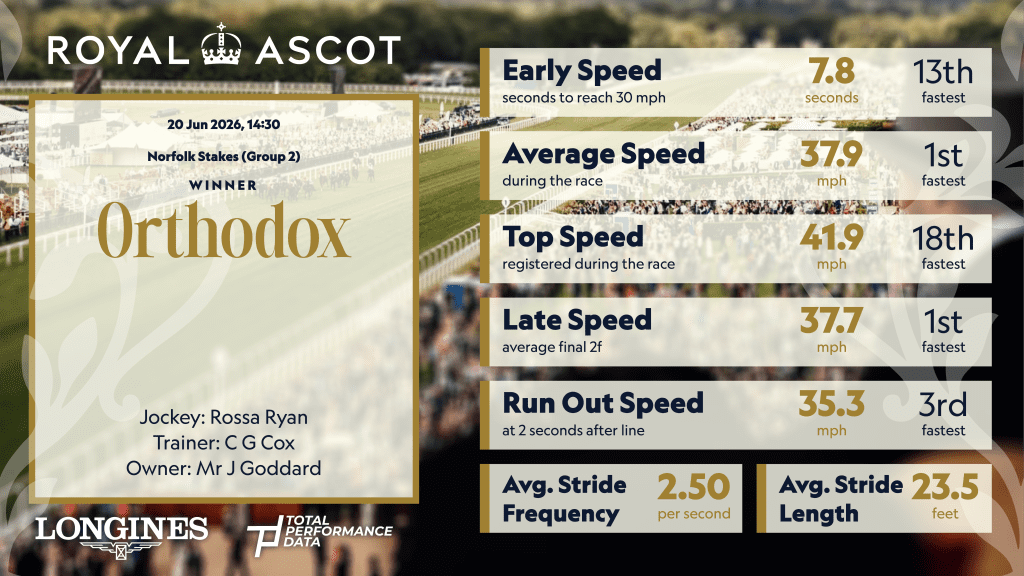
The final 2-year-old race of the meeting was run at a fast pace and the winning time recorded by ORTHODOX of 59.42s had only been surpassed by the 2025 winner of this race (Charles Darwin) in the last decade. That time was in part helped by the early speed shown by the American horses, in particular Through The Years and Fanshell Beach, who recorded times of 24.0 and 24.05s respectively for the opening quarter of a mile. That did help to set the race up and it’s no surprise to see that the best run-out speeds in the field were recorded by Mussab and Social Symbol, who were both given very patient rides. Taking all of that into account, this was a remarkable performance from Clive Cox’s winner, who won this race by over 3 lengths after coming from the middle of the pack. This was a race where the entire field recorded a top speed figure above 41 mph and the 41.89 mph recorded by Orthodox at his peak ranked only 18th. However, this son of Havana Grey recorded a race best figure of 11.55s for the penultimate furlong, which followed consecutive furlongs under 11s in the middle part of the contest. A fast pace came to the fore as we reached the final part of the week at Ascot, just take a look at the time figures run by Bacio at the end of Friday’s card if you have any doubts about that. This race was all about pace and the early leaders need to be forgiven for their tame finishing efforts given the speed that they injected when the stalls opened, but for Orthodox to win with such authority took a significant level of ability. The form of his victory at Salisbury in May has taken a few knocks in the interim period, but in both races he has run the fastest penultimate furlong in the field and has put distance between himself and the rest on both occasions. This was a special performance and his average speed of 37.9 mph made him the fastest of the 2-year-old colts that we saw at Ascot this week.