



King George VI And Queen Elizabeth Stakes Preview
Ascot - 25th July 2026
It’s time to find out. Is Calandagan the world’s best racehorse? Will he uphold the form from the Japan Cup with Masquerade Ball? Can he give weight away to the best of this year’s Classic generation? Can he still give 3 lbs to last year’s runner-up Kalpana? All of those questions will be answered at 4:10 on Saturday afternoon. In a little under two and a half minutes, over just shy of 12 furlongs of the Ascot turf, we will have the chance to see whether Calandagan can answer all of those questions and cement his place as one of the modern greats. His disappointing run in the rain and soft ground at Epsom is easily forgiven and if we take that “4” out of his form figures, then Francis-Henri Graffard’s 5-year-old has been nothing short of magnificent since winning this race 12-months ago.
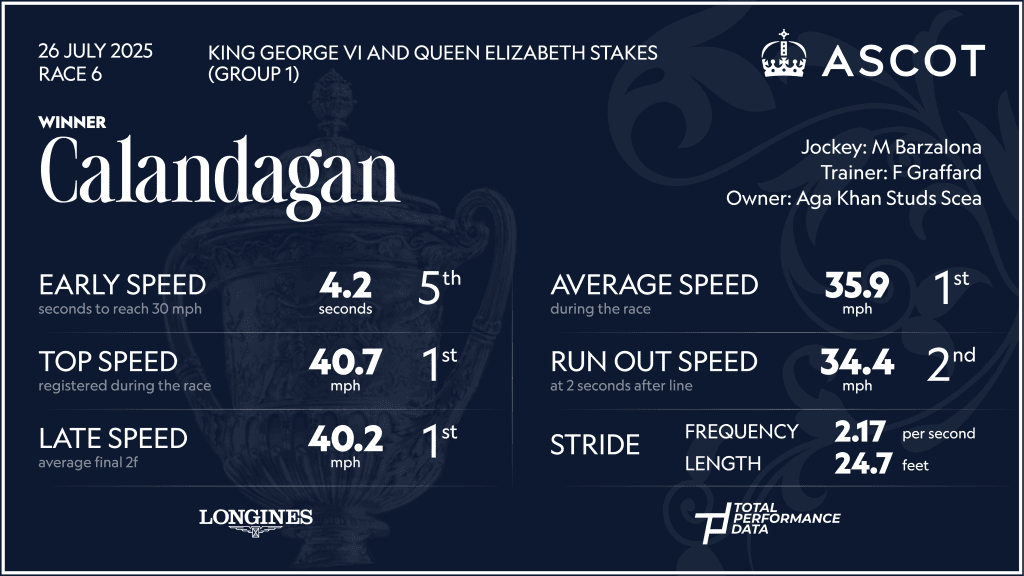
I was almost tempted to leave the infographic above without any need for further explanation. The fastest horse on the speed-o-meter, the quickest in the home straight and the best times for each of the final 3 furlong splits, the data speaks for itself and highlights how dominant the son of Gleneagles was in the 2025 race. Earlier in the week we compared his data to those of the most recent winners of the race and Calandagan came out on top for his Early Speed, Late Speed, Run-Out Speed and Average Stride Length. He is the very epitome of a top class Ascot winner and apart from a slight jockey error in the 2024 Champion Stakes (apologies Stephane) he has a perfect record at the Berkshire track. Whilst others have struggled to put a below par run at Epsom behind them, Calandagan has already bounced back by winning the Grand Prix de Saint-Cloud for a 2nd year in a row, a race where he gave the leaders a head start of over a second and ran them down with devastating speed, closing his race with furlong splits of 10.94, 10.55 and 11.18s. To add some context to those closing figures, the 10.55s that he recorded for the penultimate furlong is a faster time than Benvenuto Cellini has ever run. The flat nature of the track at Saint-Cloud does help that cause, but to Calandagan’s credit we have also recorded him running sub 11s furlongs at Meydan, York and Tokyo and that gives an idea of the task that the Irish Derby winner faces on Saturday, even with 11 lbs in his favour.
Masquerade Ball has probably come closer to beating Calandagan than any other horse in the last 12 months. Beaten by just 0.11s in the Japan Cup, it must have been an agonising watch for his supporters in November as the French superstar came at him inside the final furlong. He lost little in defeat, but it is also worth noting that he had the first run on Calandagan and yet both his Top Speed and Late Speed figures were the slower of the pair. It was a race of very fine margins and there was less than 2% between them across the range of in-race metrics provided to TPD by the Japan Racing Association. Getting within 2% of the levels set by Calandagan makes Masquerade Ball one of the best horses in the world and he does appear to be the best chance that a Japanese trainer has had to win a European Group 1 for some time. If played later, he has already shown that he is capable of matching the speed shown by Calandagan and to dismiss Takahisa Tezuka’s charge would be a mistake. He has work to do to reverse the Japan Cup form, especially on a track that clearly favours Calandagan and his finishing kick, but it is not an insurmountable task.
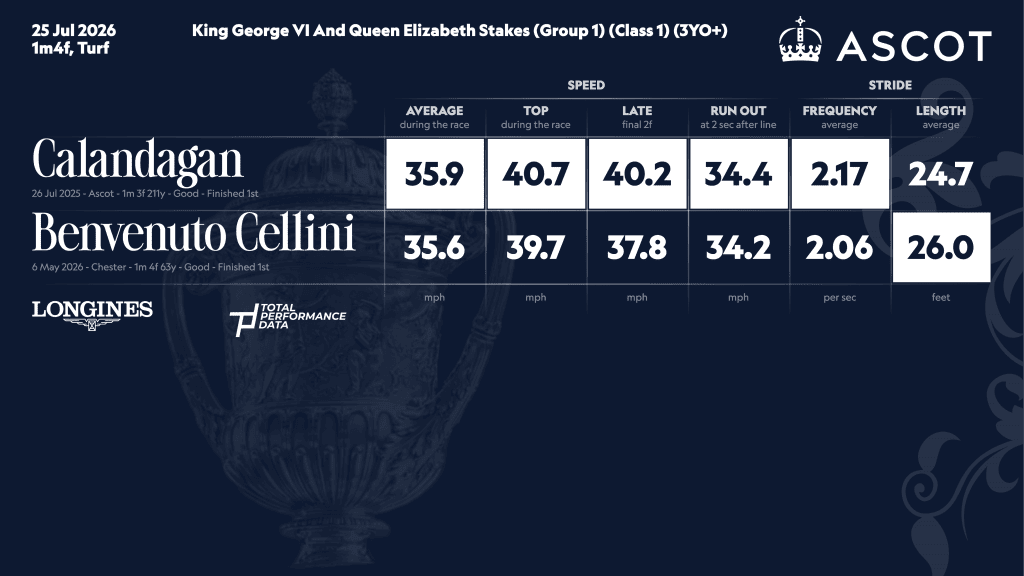
I’ve used our pre-race tool to put together the comparison above between Calandagan and Benvenuto Cellini. This compares the data that Calandagan recorded in last year’s race with the figures recorded by Benvenuto Cellini when he won the Chester Vase in May. It isn’t a perfect comparison but as Aidan O’Brien’s 3-year-old is yet to run at Ascot it is the best guide we have. As you can see, even with the weight in his favour, it seems fairly safe to suggest that Calandagan is the faster horse and if the race becomes more tactical, Benvenuto Cellini is likely to come up short. However, he does have another advantage in his favour and that is his long stride. The 26.1 ft that he recorded at Chester made him one of the longest striding horses that we have ever recorded at the track and that should help his cause in the closing stages when the field begins to climb the Ascot hill. He recorded the longest stride in the field in the Irish Derby and whatever happens on Saturday, he seems highly likely to rank 1st for that metric. If Calandagan and Masquerade Ball reach the top speeds that we know them to be capable of, then I think he will be in trouble, 11 lbs or not. However, what we can say is that his long stride should allow him to remain competitive and if the main players are tiring inside the final furlong and Ryan Moore has been able to save something, then Benvenuto Cellini is highly likely to be finishing best of all.
This has the potential to be the best race of the year. I have barely scratched the surface with this short preview and we haven’t even begun to cover horses like the Tenno Sho runner-up Wurttemberg, Minnie Hauk, the 2024 winner of this race Goliath and last year’s runner-up, Kalpana, who are all brilliant horses in their own right. I know that many of you may be reading this to look for a tip. If we’re honest the data does point towards Calandagan retaining his crown if all the horses get a clean run round at Ascot, but given that he is the pre-race favourite that probably isn’t telling you a great deal. I do have a tip though. If you’re lucky enough to be at Ascot on Saturday to watch this race, then make your way to the parade ring at around 3:45. In that parade ring you will have the opportunity to see a group of the very best racehorses in the world and whatever happens on the track, this will be a rare opportunity to see so many great horses assembled in one place. The 2026 running of the King George VI And Queen Elizabeth Stakes should be one of the best races of the year and it’s not to be missed.