


American Pharoah Stakes (G1)
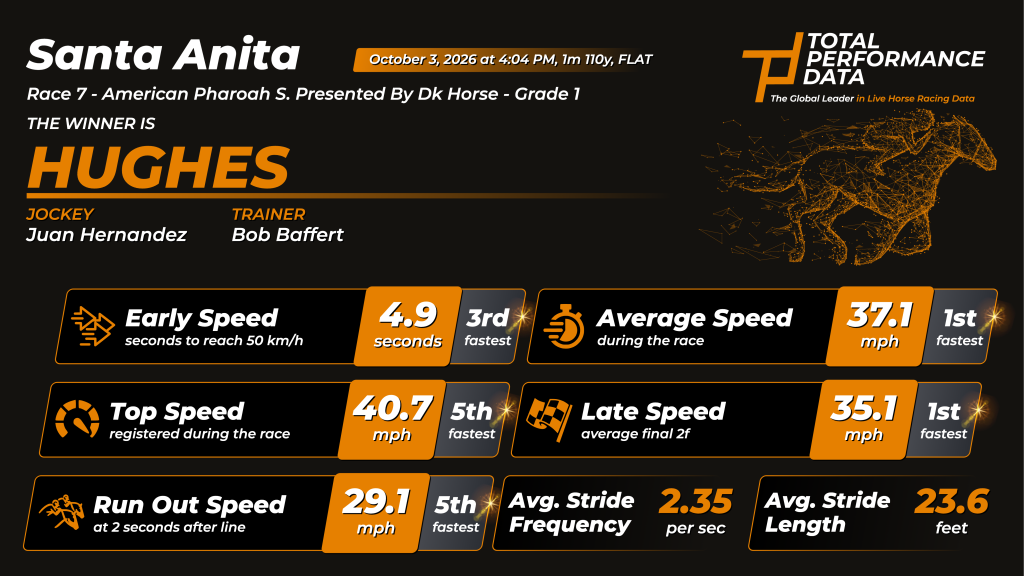 I’m going to start with HUGHES (Into Mischief – KP Dreaming). He won the American Pharoah Stakes at Santa Anita by 6 lengths and was visually the most impressive Juvenile winner of the day. Always in a prominent position under Juan Hernandez, he held the inside rail around the first turn before being brought 3 wide around the leaders as they began to swing for home. In little more than a hack canter, Hughes pulled further and further clear in the home straight with the field coming home at wide intervals. A late speed figure of 35.10 mph was a clear best and above our expected average figure for a winner of this race, although I would also add that each of his 5 rivals recorded figures well below that line. In truth, this wasn’t a particularly deep race and whilst Net Par (2nd) and Imperial Honor (3rd) are nice horses, their respective form from Del Mar would suggest they are unlikely to prove to be Grade 1 winners. However, it was hard not to be impressed by the manner with which Hughes pulled clear, recording the fastest split for each of the final 3 furlong splits and overall time that was almost a second faster than the TPD expected average. A winning time of 1:43.22 ranked 4th of the last 10 renewals of the American Pharoah Stakes (formerly the FrontRunner Stakes) and having recorded a time like that without being fully extended, I am led to the conclusion that this is one of the strongest Grade 1 performers we have seen so far in 2026. This was a 14th success in this race for his trainer Bob Baffert, who said post-race that “This is the first time he’s ever gone two turns. Juan got him to settle, and he shut it down. That’s what you need—you need a horse that can shut it off, and he did.” (Source: BloodHorse). He’s right, in the middle part of the race, Hughes dropped his average stride frequency figure from a race average of 2.35 per second to a minimum average of 2.26 per second and that helped to see him home. At a peak of just 24.27 ft, he had one of the shortest average stride length figures in the field and similar comment would apply to his victory in the Del Mar Futurity too, where he reached a longer peak of 25.05 ft (ranked 4th of 5). However, I think we need to make allowance for the fact that he has been entirely dominant in both races and as a result, he may not have needed to show us everything that he is capable of. At this stage, he is the Ante Post favourite for the race in the International markets and having achieved the most on the track, this son of Into Mischief is worthy of that market position after Saturday’s comfortable success in California.
Claiborne Breeders’ Futurity (G1)
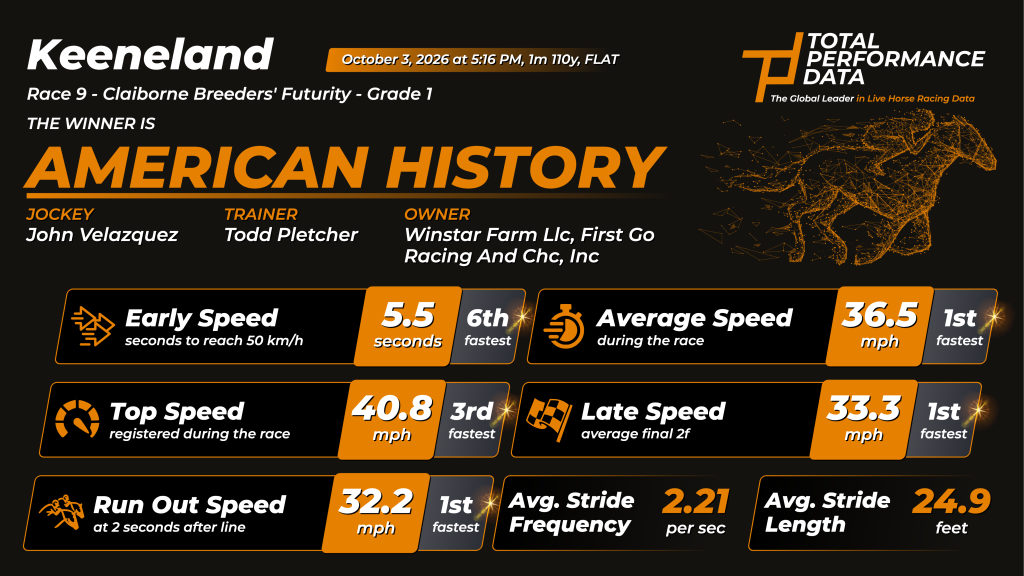 This race was won by Ted Noffey 12-months ago on his way to winning the Breeders’ Cup Juvenile, a successful route also followed by Forte (2022) and Essential Quality (2020) in recent times. The pre-race focus largely revolved around Coach Pope (2nd) who had won a Churchill Downs maiden by a wide margin in September, but instead it was the Todd Pletcher trained AMERICAN HISTORY (Constitution – Bloody Point) who took centre stage. He was also a wide margin winner of his maiden, coming clear with an impressive late speed figure of 35.84 mph to win by over 7 lengths at Saratoga in August. This race was run at a fast pace, with the winner recording a finishing speed of 91.26% and the winning time of 1:44.88 was under the TPD expected average figure for a winner of this race, although still nearly a second slower than Ted Noffey was 12-months ago (1:43.98). QB Rocket (3rd) and Coach Pope set a fast early pace, reaching the half mile pole in 52.35s. That pace gave John Velazquez a target to aim at and with his mount recording a peak average stride length of 26.62 ft, he was onboard the perfect horse to run down the leaders. Despite being 0.73s behind with just 2 furlongs to run, once into full stride, it became clear that American History was always likely to come over the top and he did so with a race best late speed figure of 33.29 mph. The front pair had clearly paid for taking each other on from such an early stage and we can see that in their stride data, with Coach Pope’s average stride length decreasing by over 3 ft in the final 3 furlongs of the race. Having won the Breeders’ Futurity, American History has earned the right to come back to Keeneland at the end of the month for the Breeders’ Cup Juvenile and if there is another strong early pace set, then he must enter the calculations. On both starts to date, he has finished very strongly and our data certainly confirms the visual impression that he is a strong stayer to keep in mind for the 10 furlong trips and beyond next year. However, the key point about this race is the fact that the leaders took each other on from the moment that they entered the back straight and they had left American History at least 6 lengths behind as they began to turn for the judge. Neither of them were able to record a peak average stride length above 25 ft, which does raise the question as to whether American History will be able to close in the same manner against better horses with more experience at this level?
Champagne Stakes – (G1)
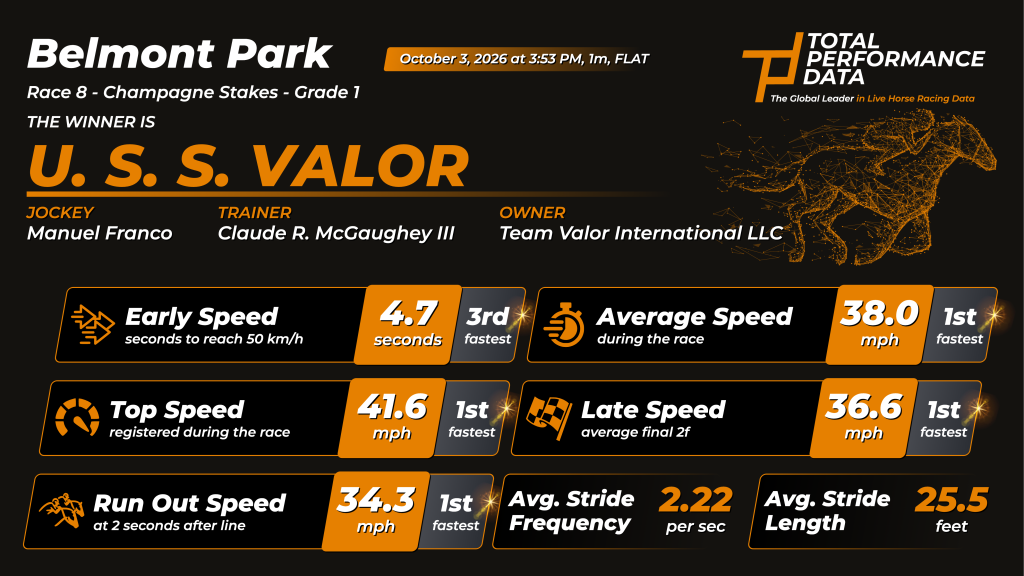 Finally we head to New York to look at the Champagne Stakes at the newly refurbished Belmont Park. U. S. S. VALOR (War of Will – Spangled Banner) had already caught the eye when winning as he liked at Saratoga in early September and that form took a boost earlier on Saturday’s card when the 3rd placed Mystic Bayou won the opening maiden race. Gaudreau (2nd) had beaten U. S. S. Valor and Coach Pope on debut at Saratoga in August in what is now looking like one of the strongest maiden races run anywhere in the US this year and it promised to be a very good test for Claude McGaughey’s charge. This was a more steadily run race and there was less than 0.3s between all 6 runners as they reached the crown of the turn, with the winner recording a finishing speed of 97%. Initially forced to wait for the gaps to appear in front of him, U. S. S. Valor had to barge his way out to get racing room in the home straight, but once into the clear, he quickened readily to run race best splits of 12.01 and 12.38s for the final 2 furlongs. I was particularly impressed by the way that U. S. S. Valor lengthened when he got into the clear and his average stride length stretched to a peak of 26.96 ft from a race average of 25.54 ft (a variance of 5.6%). In a compact field, the fact that he was able to put 6 lengths between himself and the remainder of the field speaks volumes about his ability and he ranked 1st for all of our in-race speed metrics to back that up. It’s simply too early in the new season at Belmont Park to be able to offer any significant comments about how this data compares to the other winners that we have seen on the track so far, but U. S. S. Valor ticked all the right boxes and readily reversed the debut form with Gaudreau. McGaughey said he and Team Valor president Barry Irwin will see how U. S. S. Valor exits the Champagne before they decide the colt’s next start (Source: NYRA) but having earned a spot in the Breeders’ Cup Juvenile with this victory, a trip to Keeneland must surely be tempting if U. S. S. Valor comes out of this race in good shape.