William Hill Futurity Trophy Stakes (G1)

Doncaster - 24th October 2026

“He’s heading in the right direction with the right connections, but I would like to see him do this again before taking the view that he is the one for the Derby honours”

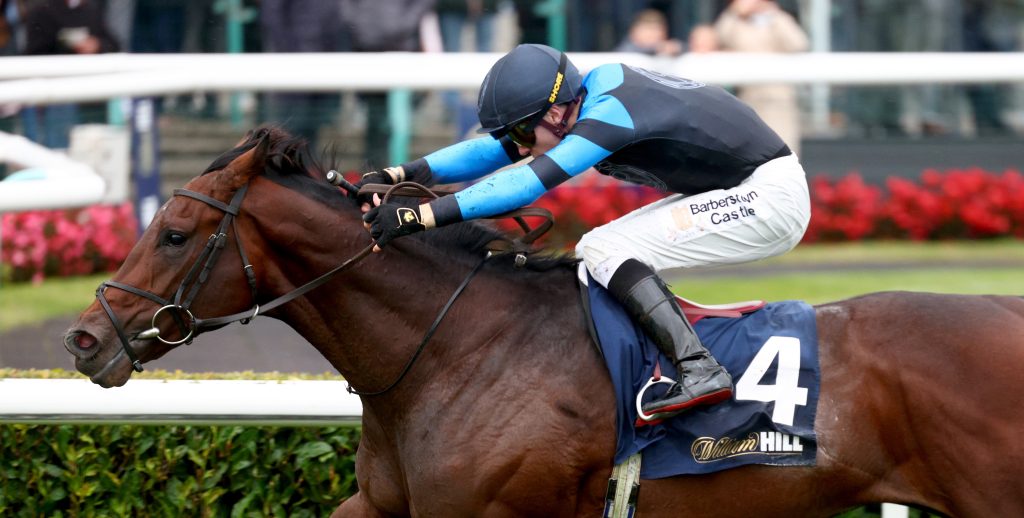
Giant Sequoia and Dylan Browne McMonagle (black) winning The William Hill Futurity Stakes Doncaster 24.10.26 Pic Dan Abraham-focusonracing.com

Aidan O’Brien winning the final Group 1 of the British and Irish Turf seasons should not come as a surprise. The champion trainer elect had won 3 of the last 5 renewals of the Futurity Trophy and after Saturday’s success he now has a record 13 victories in the Doncaster showpiece. Hawk Mountain had led home a 1,2,3 for the Ballydoyle team in 2025, with subsequent Irish Derby winner Benvenuto Cellini only 3rd. As a general rule, the race has been won by the stable’s first string and you have to go all the way back to Aristotle’s victory in 1999 under George Duffield to find a winner for Aidan O’Brien that returned a double figure SP. With that in mind, does the fact that GIANT SEQUOIA won as the 11/1 outsider of the field and the 3rd choice of the Ballydoyle runners according to the betting and jockey bookings mean that this form is open to question?

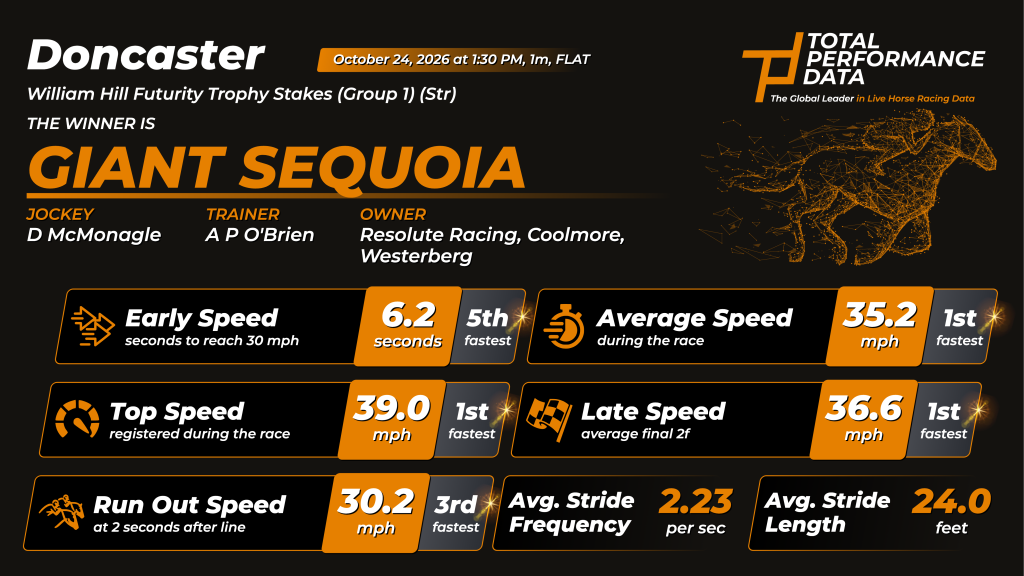
The ground was described as heavy on Saturday afternoon. A winning time of 1:42.30 was 1.49s under the TPD expected time for Heavy ground conditions and it was the fastest time since Mac Swiney won the race in 2020, with each of the last 6 renewals being run on ground described as either Soft or Heavy. There were 5 races of the 8 on Saturday’s card that recorded times under the TPD expected time figure, compared to just 2 on the same card 12 months ago, so whilst the ground was clearly deep, it wasn’t quite as bad as it can be for this meeting. A finishing speed of 104.5% from the winner points to a race run at a relatively even pace, with the field heading towards the stands side rail in the early stages, but having made his challenge widest of all, the winner didn’t look to be inconvenienced by coming down the centre of the track. Given the Summer that we have had, this was the deepest ground that any of these 2-year-olds have encountered in their careers, but the time figures would lead me to the conclusion that it wasn’t a result that can be entirely attributed to the going conditions. As can be seen from our data summary above, Giant Sequoia ranked 1st for each of our in-race speed metrics and the run-out speed of 30.2 mph, ranked only 3rd, can easily be accounted for by Dylan Browne McMonagle easing up when it became clear that he had the race won. Sergei Diaghilev did his job as the pacemaker and towed the field to the halfway point in 52.34s, over a second quicker than Hawk Mountain had been when making all to win this race in 2025. Having been given a pace to track, I couldn’t find any real excuse for the beaten favourite Noble Exhibit, who hit the front under Ryan Moore with a race best 12.05s split for the 6th furlong. His stride frequency peaked at that point, but it quickly fell away and he simply couldn’t sustain the effort. Despite recording longer stride length averages than he had when winning in Ireland, his stamina was stretched under these conditions and with both wins in Ireland coming in races run at a more steady gallop, he may have found this simply too far at this stage of his career. Having made his debut in late August, he has come a long way in a short space of time, as has the runner-up Gran Dia, who ran a superb race having only made his debut at Salisbury on 1st October. With the exception of the winner, Gran Dia finished his race best of all and his time of 13.00s for the final furlong was more than half a second quicker than those in behind him. He rounded off that finish with a race best run-out speed of 31.05 mph and is very much a horse to look forward to next season, but I don’t want to make any excuses with this analysis because the data would support the view that the winner was dominant on the day.

Although he was sent off as the outsider of the 7-runner field, that SP would look to be a reflection of just one piece of form. He was sent off as the 4/9 favourite on his debut at the Curragh in June and quickly made amends for that debut defeat with a win over the same course and distance 4-weeks later. He struggled in the National Stakes behind Folsom Blues, but the pace collapsed that day and he came off the bridle at halfway. That form has worked out reasonably well, with the winner finishing runner-up in the Prix Jean-Luc Lagardere, the 4th placed Trean going on to win the Goffs Million and the 7th placed Haffner going on to win the Royal Lodge. On that basis, the run was arguably one of the better pieces of form on offer from these 2-year-olds. Giant Sequoia traveled nicely behind the pace and picked up readily when he was asked to. Once he moved alongside Noble Exhibit, his stablemate had no answer as Giant Sequoia clocked 11.58s for the penultimate furlong, the fastest split of any of the runners in the latter half of the contest. He was the only horse in the field to record an average stride length above 24 ft, as well as being the only runner to reach a top speed above 39 mph. He clearly handled these conditions better than any of his rivals, but having won 3 of his 5 career starts, he did end his 2-year-old season in progressive fashion and whilst the conditions played their part, it would be a mistake to entirely dismiss him. 

At the time of writing, he is a 12/1 shot for the Derby in June. I’m in no particular rush to take that price. Not because I wasn’t impressed by the way that Giant Sequoia won this race, but more because it was clear that plenty of his rivals simply didn’t handle the conditions. His dam, Pink Dogwood, was 3rd in the Irish Oaks in 2019 and is a half-sister to the Irish Derby winner Latrobe. Although Giant Sequoia is the first of her progeny to win on the track, there are plenty of winners in this pedigree and everything on the page would point to this son of Frankel improving as a 3-year-old over further. The ground makes it hard to form too many opinions on what he may do over 12 furlongs in time, especially on a faster surface, where he will need to prove that he can settle behind a faster pace. A minimum average stride frequency of 2.14 per second was the lowest in the field and similar to the 2.12 recorded for Benvenuto Cellini in this race a year ago. It’s a good sign, but he had plenty of cover behind horses who were all slowing down once they went past the 2 furlong pole, which seems less likely in the Classics next year. He’s heading in the right direction with the right connections, but I would like to see him do this again before taking the view that he is the one for the Derby honours.