



Bahrain International Trophy (G2)
“Royal Champion”
When previewing this race it became apparent that there didn’t appear to be an obvious pace angle amongst the 8 runners and as a result, there was perhaps an opportunity for an enterprising ride from one of the jockeys, who may be able to control the race from the front. That opportunity was seized by Dylan Browne McMonagle aboard the Joseph O’Brien trained Galen, who was the fastest horse to reach the mile marker with an opening split of 27.79s. He took just 5.8s to reach 30 mph when the stalls opened, the same time as the eventual winner Royal Champion as it happens. The race was far more complex than the simple assumption that the 2 fastest starters finished in the first 2 places, but when we consider that the 3rd placed Military Order took 7.2s to reach the same speed and he was eventually beaten by just 0.2s as they crossed the line, the importance of getting into that early position should not be overlooked entirely. The plan almost worked aboard Galen, who was still in front with a furlong to run, but he simply couldn’t repel the late challenge of his superior rival, despite the fact that he recorded a much longer average stride length (24.77 ft). A finishing speed of 105% from Galen, compared to the 101.5% finishing speed recorded by Spirit Dancer when he won this race 12 months ago, confirms that this year’s renewal developed into a more tactical affair, but the winner ran the final 3 furlongs in 34.11s. That was 2.02s faster than Spirit Dancer over the same part of the course 12-months ago and Royal Champion recorded a winning time of 2:01.58, 0.7s quicker than Spirit Dancer. So, the time data tells us that despite the slower pace in the early part of the race, Royal Champion has been able to overcome that bias to put in a better performance than the winner of last year’s renewal.
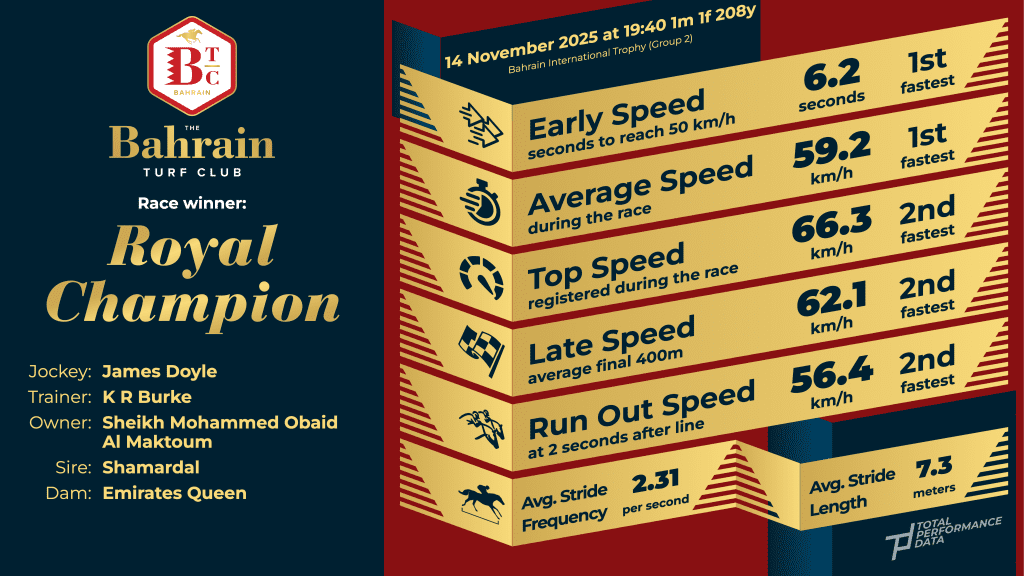
Although slightly keen in James Doyle’s hands, Royal Champion was able to settle once Pride of Arras came across him at the end of the 2nd furlong and he maintained a consistent average stride frequency of 2.25 per second for furlongs 4, 5 and 6. The pace lifted with 4 furlongs to run and that suited perfectly as Royal Champion came towards the centre of the straight, reaching his peak stride frequency figure as they entered the final quarter of a mile. A top speed figure of 41.18 mph outstripped the 40.91 mph recorded by Galen and Karl Burke’s charge was perfectly placed to run down the long time leader, despite the fact that he didn’t run the fastest individual furlong at any point in the contest. His peak average stride length of 24.82 ft ranked only 6th, but in a race run with a relatively tactical early pace, being in the right place at the right time and having the turn-of-foot to get to the front, was ultimately the difference between winning and losing. In hindsight, he was perhaps an obvious winner. A horse that came into this contest with proven Group 1 form from the Irish Champion Stakes in September, where he was beaten just 3 lengths by Delacroix. If we were to take their European ratings literally, then it might be considered that he ran slightly below par to beat the 114 rated Galen by just three-quarters of a length. However, the pace bias massively favoured Galen, especially given the way that Dylan Browne McMonagle chose to ride him and as a result, Royal Champion has at least run to his rating of 119 in order to run him down and this performance should be treated in that bracket based on my interpretation of the data.
I don’t intend to review the performance of all 8 runners. At this pace, every horse had their chance and the cream definitely rose to the top, but if there is a horse who was perhaps a slightly unlucky loser, it must be the 3rd placed Military Order. Having raced towards the rear, he was given a very difficult task, but he was the fastest horse in furlongs 7, 9 and 10, coming home in a time of 45.33s for the final half a mile. To add some context to that figure, Royal Champion ran the final 4 furlongs in 45.55s. A top speed of 41.29 mph was also the best figure amongst the 8 runners, as was the run-out speed of 35.21 mph that Military Order recorded 2s after he crossed the line. In a race that favoured those that raced closer to the pace, he made up a significant amount of ground and recorded a longer average stride length (24.79 ft) than either of the horses to finish ahead of him. At the time, his defeat behind Silawi in the Winter Hill Stakes at Windsor in August seemed like a regressive piece of form, but the winner has since won the G1 Canadian International at Woodbine and Military Order lost very little in defeat to Royal Champion in this race. On both occasions he has run the fastest final half a mile in the race and it would appear that he is starting to return to the level of form that he showed as a 3-year-old. He has a good record on an artificial surface and that means that he has plenty of options over the winter, but were he to go on to Dubai or Saudi Arabia in the months ahead, it is not impossible to think that there could be a big prize to be won with him next time, especially on a more stamina favouring track.