Qatar Racing British Champions Day Two-Year-Old Conditions Stakes
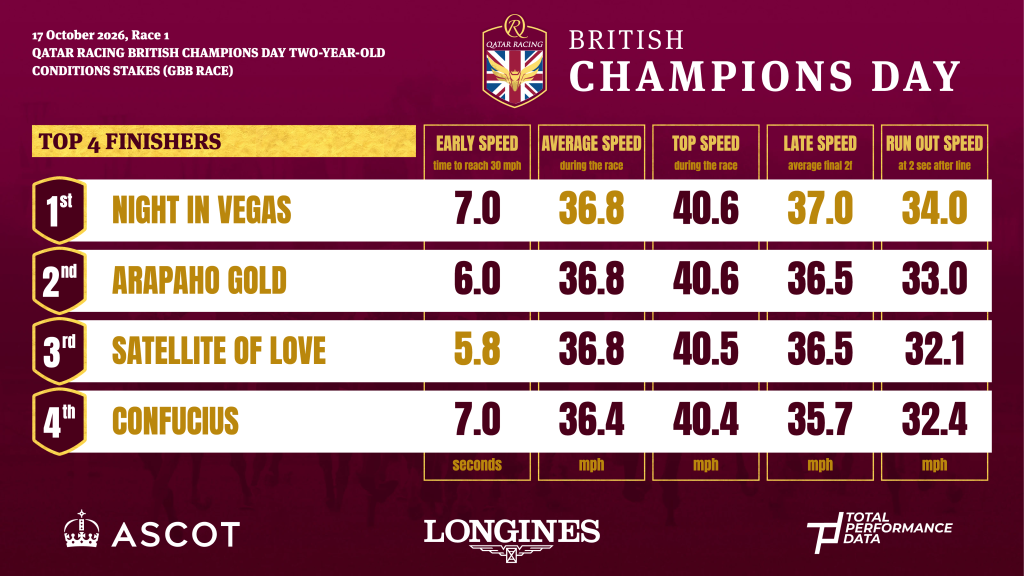
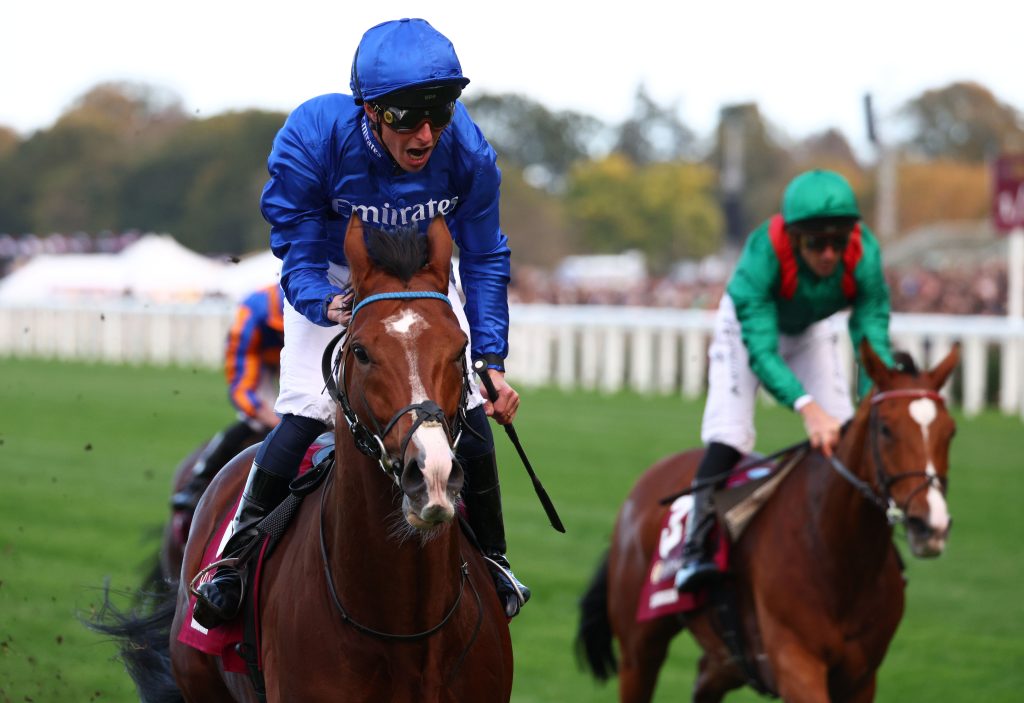
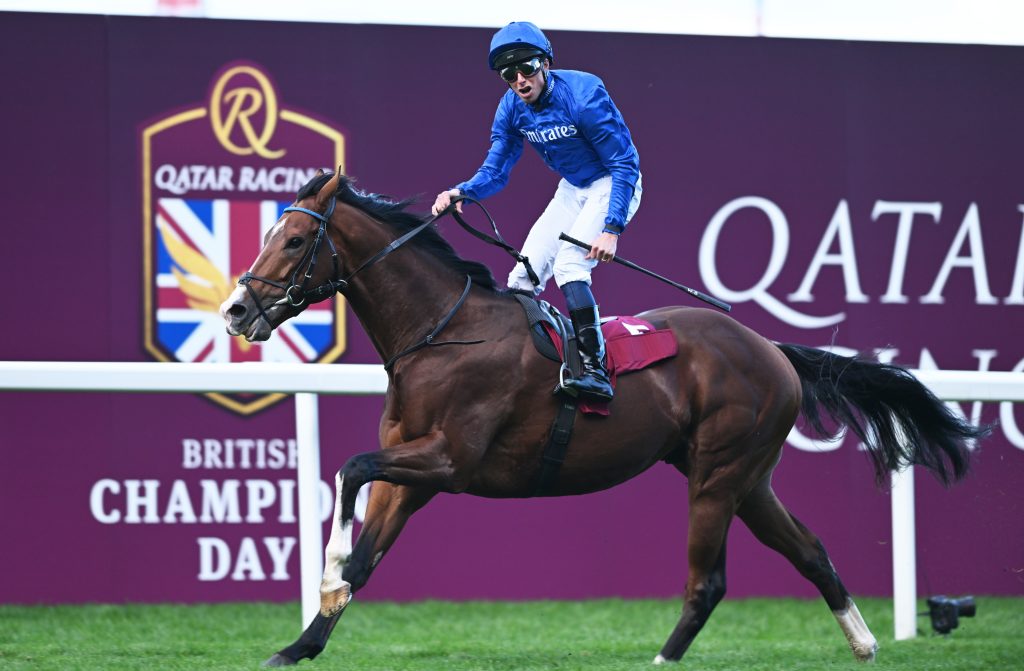
What a start to Champions Day! Night In Vegas has had a wonderful season and having already taken his connections to the winner’s enclosure on 4 occasions and gone through the £500,000 prize-money barrier, he capped a superb year by taking this 2-year-old prize. That being said, this was a victory by the very narrowest of margins and with less than 0.01s between himself and the runner-up (Arapaho Gold) at the line, Michael Dods horse can certainly be considered to be a slight unlucky loser. After only a couple of renewals of this race which was inaugurated in 2025, it is hard to form any serious opinions as to what trends to look for. However, last year’s winner Mission Central went on to win the King Charles III Stakes and Night In Vegas has done very little wrong and must at least have his connections harbouring those kinds of ambitions after this success.
Arapaho Gold and Satellite of Love set good fractions, covering the first 3 furlongs in 37.70s and setting the race up to record a winning time that was over a second faster than our expected time figure. At an average of 24 ft, Arapaho Gold had the longest stride in the field, but despite getting the first run, the battle for the lead with the eventual 3rd may just have weakened his finishing effort by enough for Night in Vegas to be able to run him down. Eve Johnson Houghton’s charge came home with a race best late speed figure of 37 mph and having recorded a run-out speed of 33.98 mph (measured 2s after they crossed the line) that was more than 3% quicker than Arapaho Gold, Night in Vegas had earned the right to get his head in front, even if it was by just a few millimetres. Although there was clearly a slight advantage for those that raced prominently, a finishing speed of 99.92% from the runner-up and an average speed of 36.78 mph, within 0.2 mph of the fastest time from a 2-year-old over the course and distance this year (Libertango, Albany Stakes – 36.92 mph) suggests this is a strong piece of juvenile form. With that in mind, I think we can at least upgrade the form on the strength of the time and given how well Night in Vegas has taken his racing this year, he certainly wasn’t winning out of turn. Although beaten in the Coventry and the Richmond Stakes earlier in the season, his trainers post-race comments suggested that he might not have been spot on for those assignments and after winning several valuable races throughout the year, he may yet prove capable of taking the step into pattern company next year based on this evidence.
Qatar Racing British Champions Sprint Stakes
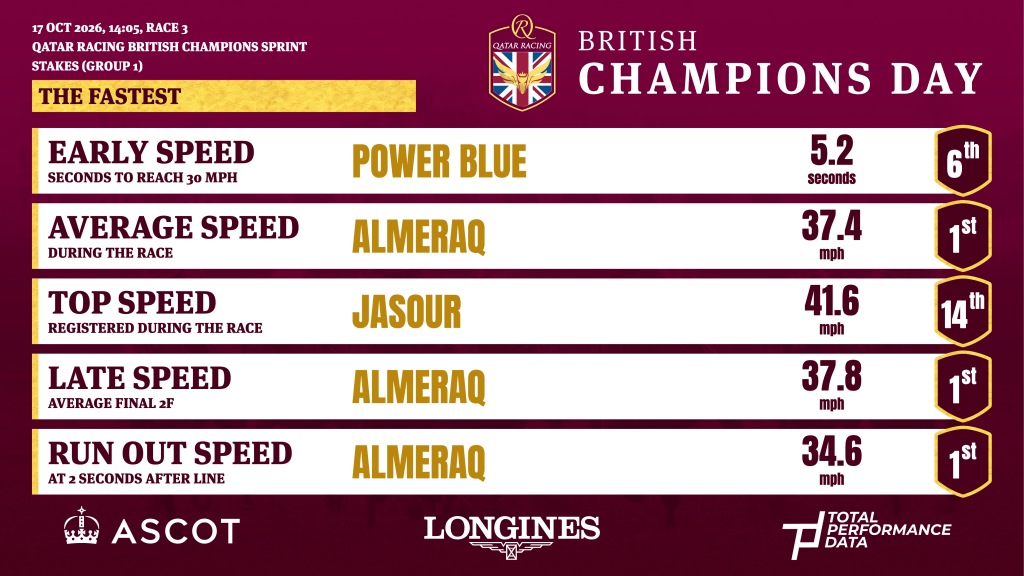
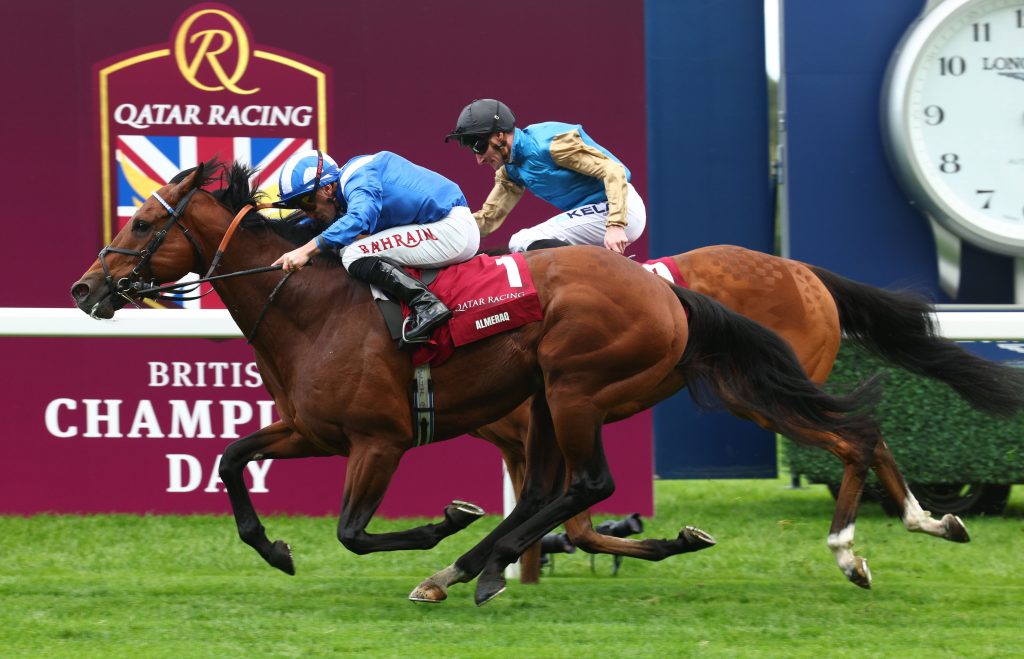
A Champion Sprinter for Champions Day. It’s been quite a few years since we had a sprinter as dominant in the division as Almeraq has been this year, but the 4-year-old Dark Angel colt confirmed his place at the head of the rankings in Saturday’s Champion Sprint. When he gets cover to race in behind, the 4-year-old has proven himself to be the best sprinter around and this was the 3rd time this season that he won a Group 1 sprint with a race best late speed figure. The runner-up, Paborus, was given a very enterprising ride by Danny Tudhope along the far side rail and he got significantly closer than he had at Haydock, but once in the clear, there was a sense of inevitability that Almeraq was always going to get there in time. Paborus had almost a quarter of a second in hand when he hit the front, but Almeraq found plenty when he needed to as he closed with race best furlong splits of 12.25 and 12.88s. That final furlong split was 0.78s quicker than the runner-up and with a gap of over 3 lengths back to the 3rd placed horse (Division) the pair had pulled comfortably clear. A winning time of 1:12.20 was under the TPD expected time figure for this race and only last year’s winner Powerful Glory has gone faster in this race in the last decade.
As an entire, his connections now have a decision to make about his future, but either way he has left his mark on the sprinting division after a superb 2026 campaign. It is not an easy task to win several Group 1 sprints in a single season and his defeat in the July Cup can easily be excused by the fact that the field divided in front of him at the start and he was left without cover. Although he hasn’t produced an explosive turn-of-foot to win these races (all 3 successes have come in races where Almeraq has not run a sub-11s furlong split), he has shown himself to have the ability to travel into a race and then find the required late speed to get his head in front when it mattered.
Qatar Racing British Champions Fillies & Mares Stakes
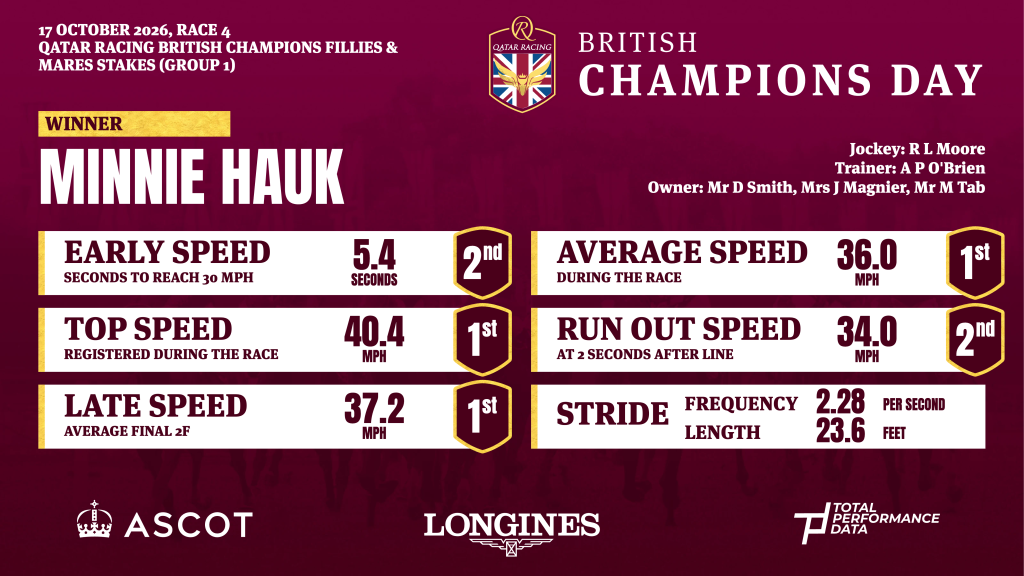 Stall 1 may not have a good record over this course and distance at Ascot, but I don’t think that can be used as an excuse for Kalpana’s defeat. When winning the King George VI and Queen Elizabeth Stakes in July, she stretched to a peak average stride frequency of 2.47 strides per second, compared to just 2.39 on Saturday and a longer peak stride of 25.53 ft would suggest that she was reaching in the closing stages. This performance should not detract from a top class career and whilst the run in the Prix de L’Arc de Triomphe 13 days earlier may have left a mark on the beaten favourite, it certainly didn’t affect the chances of the winner, Minnie Hauk. This was Aidan O’Brien’s first success in this race since Magical in 2018, but whilst the front-running tactics from the Ballydoyle team have come in for some criticism this season, they got things spot on in this race. Christophe Soumillon got Sugar Island to the front as she recorded a race best 5.2s time to reach 30 mph when the stalls opened. From there, the pair could control the pace and Sugar Island reached the halfway point in 1:14.72. That allowed the winner to get the first run on the field once they turned for home and that allowed her to quicken away with race best closing splits of 11.68 and 12.34s. As our infographic shows, Minnie Hauk dominated the in-race speed metrics and was comfortably on top, but I think the data would suggest that this race was really won at the start.
Ryan Moore made light of his high draw and kept Minnie Hauk wide, clocking the fastest split of the entire race when he and Minnie Hauk ran 11.23s for the 2nd furlong as they ran down into Swinley Bottom. That allowed Minnie Hauk to slot into her prominent position behind her stablemate whilst keeping her stride frequency under control. Never higher than 2.34 strides per second in the opening 3 furlongs of the race, she made that forward move on a downhill part of the track and Ryan Moore was able to limit the amount of energy that Minnie Hauk used in order to get into that ideal spot. In-race decisions like this are why Ryan Moore was inducted into Racing’s Hall of Fame on Saturday.
Queen Elizabeth II Stakes
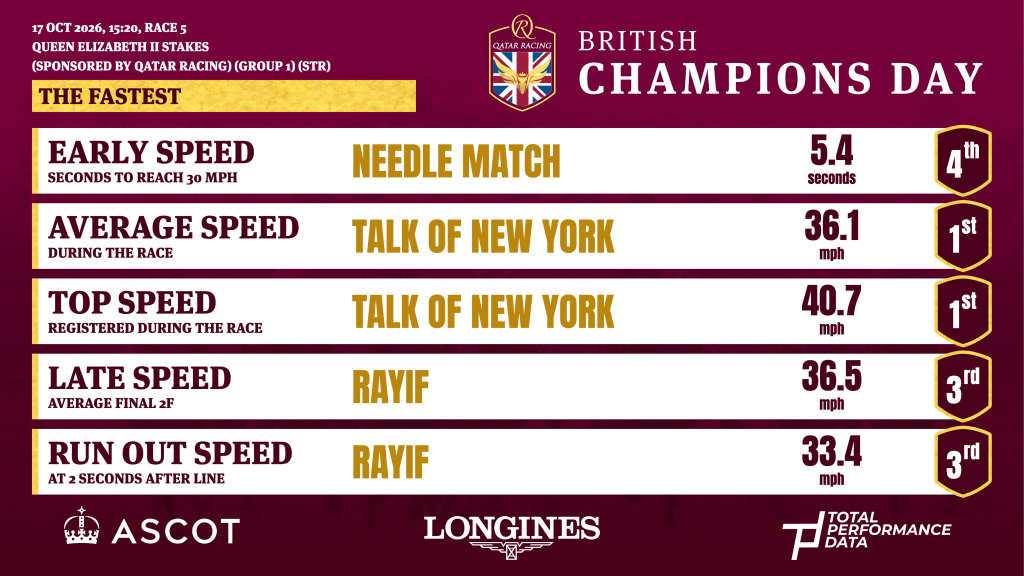 When Bow Echo retired through injury in August, it left a hole in the Mile division, but there is a definite chance that Talk of New York could fill that gap. Needle Match ran a huge race at a big price and set a really even pace, with a range of just 0.3s across his mid-race sectional times. Having quickly mastered Gstaad, Talk of New York probably got to the front too soon, but the Wootton Bassett colt still found enough for William Buick to win by over a length. Beating a Queen Anne winner (Ten Bob Tony) and the French 2,000 Guineas and Prix Jacques Le Marois winner (Rayif) should not be underestimated. A case could be made that Rayif was slightly unlucky and having clocked the fastest split for each of the last 3 furlongs, Francis-Henri Graffard and his team can be very proud of the season that they have had with this 3-year-old, who lost very little in defeat on Saturday afternoon. However, Talk of New York had been far too keen in the St James’s Palace Stakes earlier in the season and yet he had still managed to finish within a couple of lengths of Bow Echo. On the balance of the form book we had available, that was probably the best individual run in the field with the exception of Gstaad. On Saturday, unlike in June, Talk of New York relaxed and dropped to an average stride frequency of 2.26 strides per second in the 4th furlong. By conserving more energy in the middle part of the race, he had enough left for the climb up to the line and was able to win this year’s QEII with something in hand, even if he may well have preferred to get a longer lead into the contest. At Newmarket in September, he reached a peak average stride length of 26.76 ft, fully 2 ft shorter than he reached at Ascot on Saturday, but now that he settles, the need to get early cover and perhaps race around a bend seems to have gone.
Whilst some of his rivals may have been over the top by this stage or in many cases simply been not quite up to this level, Talk of New York took a very big step forwards and if he remains in training, there is every chance that he could prove to be the dominant miller on the turf in 2027 if he continues to mature as a racehorse.
Qatar Racing Champion Stakes
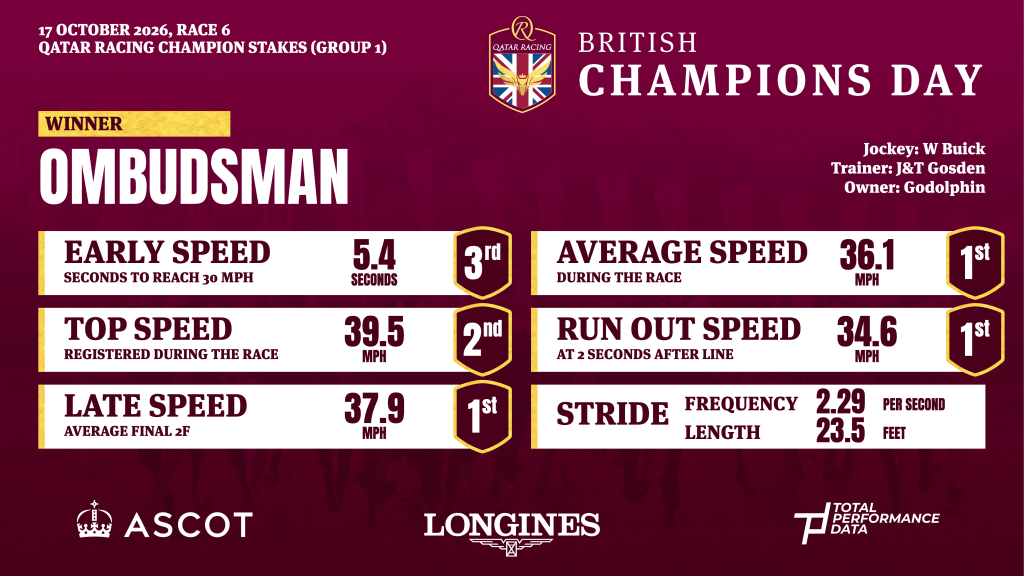 This was a fifth Group 1 success for Ombudsman, who signed off a remarkable Ascot career with a really dominant display in the Champion Stakes under William Buick. He might go to the Breeders’ Cup or this may have been his final swansong before he goes to career at stud, but either way Ombudsman has left his mark on Ascot folklore. On quicker ground, Ombudsman is almost impossible to beat at this track and giving a three and three-quarter length beating to Calandagan is an incredible way to bow out from the Berkshire track. As you can see from our in-race graphics above, when it mattered, Ombudsman was simply too quick and a late speed figure of 36.09 mph was the 2nd time this season that he has recorded a top 10 late speed figure over the course and distance for 2026.
This was a smaller field than last season and a winning time of 2:04.22, which was 1.71s outside the TPD expected time, was over a second slower than Calandagan had been when winning the race in 2025 on ground also described as “good”. Devil’s Advocate did his job, setting even fractions and getting to the halfway point in 1:03.36, but that was nearly a second slower than he had when fulfilling a similar pacemaking role in this race 12-months ago. That subtle drop in the early pace made all the difference. Calandagan was the fastest horse in the penultimate furlong (11.34s), as he had been in this race last year, but with a more prominent ride and a more tactical race, Ombudsman was simply too strong. The Gosden’s 5-year-old has won a pair of Prince of Wales’s Stakes with race best late speed figures on both occasions and once brought out to make his challenge, he went away readily as he averaged 37.87 mph in the home straight. On a side by side comparison, Calandagan has the much longer stride of the pair and as they came around the bend, his stride frequency peaked above Ombudsman too, but he couldn’t sustain that effort on ground that was probably lively enough for the French superstar. When asked to go and win the race, Ombudsman peaked and reached an average stride frequency of 2.41 per second as he clocked 11.95s for the last furlong. That final split time of 11.95s was the fastest final furlong run by any horse at Ascot on Saturday and highlights just how much speed Ombudsman possesses in the closing stages up the Ascot hill. William Buick was riding at his very best on Saturday and it is a rare thing indeed to see someone ride a hat-trick of winners on a card as deep as this one, but he was always in the right place on Ombudsman this year and once he brought his mount out for a run, he went away like the 125+ performer that he is.
Whether he goes to Keeneland or whether this victory in the Qatar Racing Champion Stakes is his final bow, Ombudsman will end his racing career as one of the best 10 furlong horses to have graced the Ascot turf.