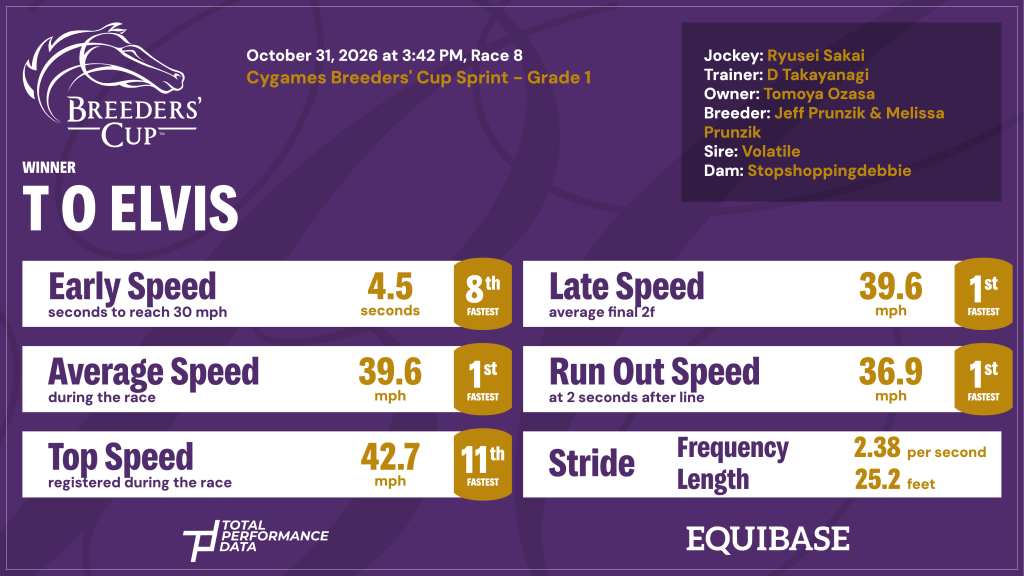
Cygames Breeders' Cup Sprint (G1)

Keeneland - 31st October 2026

“After the Breeders’ Cup Sprint, we now know twice as much about T O Elvis as we did before and everything in our data would suggest that this horse is a Superstar”.

This was a fantastic Breeders’ Cup. There are so many stories to tell. Bob Baffert winning a seventh Breeders’ Cup Juvenile, Aidan O’Brien equalling his own record for the number of Group 1 victories in a calendar year, Sovereignty bowing out at the pinnacle of the sport, Nitrogen getting her turn, Bacio emerging as one of the best turf sprinters in the world. All of those stories are worth telling, but in my opinion, the star that shone brighter than any other at this year’s Breeders’ Cup was the winner of the Cygames Breeders’ Cup Sprint, T O Elvis.

So far this year, Total Performance Data have recorded data for 126 graded or stakes races over six and seven furlong trips on the dirt in North America. An average speed of 39.59 mph makes T O Elvis the fastest winner on the clock in all of those 126 races. Englishman recorded an average speed of 39.47 mph in the Breeders’ Cup Sprint which ranks 3rd on that list from a sample that includes over 850 runners. That’s a nice headline making statistic, but there is much more to this victory than just a fast time on the clock. The manner of this victory and the way the race played out for Ryusei Sakai and T O Elvis and most importantly of all, the horse that he was able to run down inside the final furlong make this the most impressive victory by a Japanese horse that we have seen at the Breeders’ Cup. Forever Young’s triumph in the Classic at Del Mar in 2025 was superb, but what T O Elvis did on Saturday afternoon was a statement. A sign that the Japanese horses will continue to compete on the dirt with the best of their American counterparts.
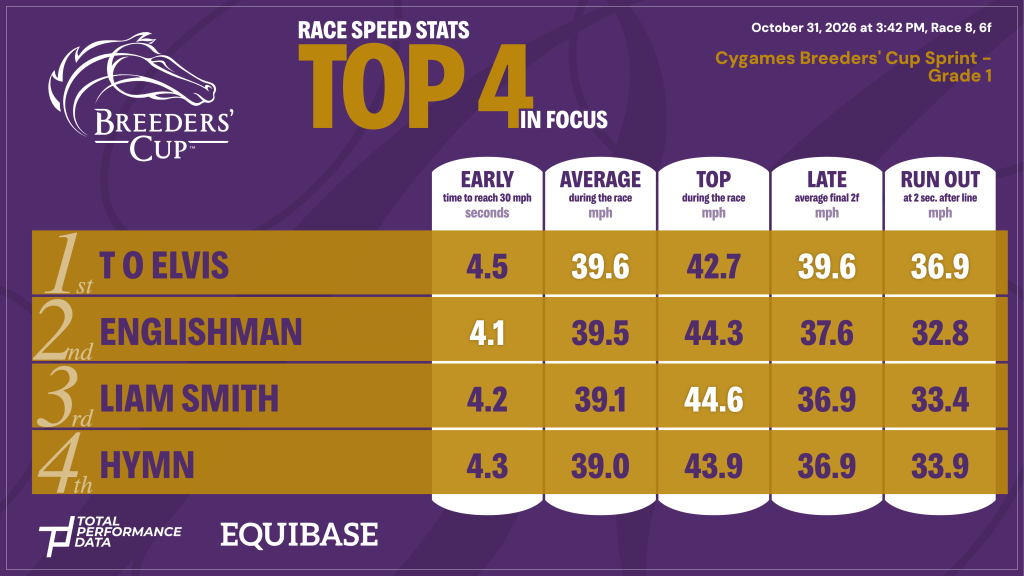
Englishman had laid all before him this year. He is a fast horse who reached a top speed of 44.28 mph as he blasted away from the stalls at Keeneland. His second furlong split of 10.32s was the fastest split in the race and with Liam Smith for company, he set his usual frantic early gallop. The pair got to the halfway point in under 33s and with T O Elvis a full second behind at that point, it looked like this was going to be the procession that the earlier markets had suggested it would be. However, T O Elvis was far from done and despite having to make his way between horses to get the racing room he needed, once into the clear in the centre of the track, the four-year-old son of Volatile took off. With a split time of 11.25s for the penultimate furlong, T O Elvis was one of only two horses to quicken into the 5th furlong (Little Thunder 11.65s was the other) and he found 0.29s at that point. Even more impressively, despite still being the best part of four lengths behind Englishman with a gap of 0.66s between them as they passed the furlong pole, T O Elvis found a closing time of 11.52s, more than three-quarters of a second faster than any of his rivals. 

I have included our summary of the in-race metrics recorded for the first four horses to cross the line because I think it serves as the best example of just how dominant the winner was. As expected, he had the best late speed figure in the field at 39.59 mph, but that late speed figure was nearly 2 mph faster than any of his rivals and 1.6 mph faster than any horse has recorded on the dirt track at Keeneland in 2026. When Bentornato won this race at Del Mar in 2025, his run-out speed was 35.32 mph. Keeneland is a different track when compared to Del Mar so that does need to be accounted for, but despite having to make up more than a second on Englishman, T O Elvis reached 36.93 mph when he ran through the line on Saturday. Having been forced to race further back than ideal and having had to make his way through the field to get a clear run, the data would suggest that T O Elvis had to reach heights that very few sprinters have managed in the last 20 years. I can’t find any reason to suggest that Englishman didn’t run his race. His top speed, early fractions, stride length and stride frequency data are all above the numbers he recorded when winning the H. Allen Jerkens Memorial at Saratoga in August and his average speed figure compares closely with the 39.18 mph that he recorded when equalling the track record in the Woody Stephens in June. He had a wide draw to overcome, though the winner also came from a double-figure stall, but the race looked to pan out the way we imagined it would for Englishman. Perhaps a case could be made that he is better over the seven furlong trip than he is at six. Unlike at Saratoga, there was no opportunity to ease slightly on the pace at halfway and take an opportunity to conserve some of his energy. His minimum average stride frequency was higher at Keeneland than it has been in New York, but it’s a difference of less than 1%. 

Englishman had every chance and was simply beaten by a better horse on the day. The pair of them finished 0.67s clear of the rest and the fact that Liam Smith held on for 3rd despite his early exertions in front would suggest to me that there was no disadvantage to racing prominently. When I wrote the preview for this race last week, I said that we only had one piece of evidence to make a case for T O Elvis and that we knew a lot more about Englishman. The Breeders’ Cup Sprint looked to be a match race between the pair and so it proved, but we have seen a lot more of Englishman and so it was easy to understand why there was so much confidence behind him. T O Elvis had been very impressive when winning the Churchill Downs Stakes in May, but that was our only opportunity to date to record data for him and as a result, we needed to see him do it again to be sure that it wasn’t a “one off” performance. After the Breeders’ Cup Sprint, we now know twice as much about T O Elvis as we did before and everything in our data would suggest that this horse is a Superstar.