


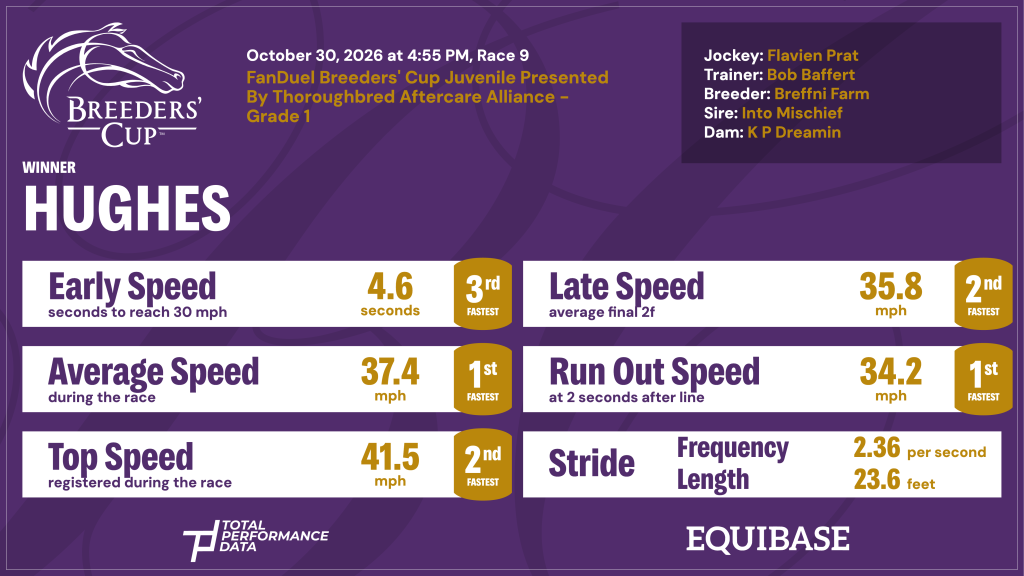
 To win 5 consecutive races as a juvenile is an exceptional feat, especially when 3 of those have come at the highest level. Any doubts about the strength of the California form can now be dispelled as Hughes has now beaten some of the best juveniles we have seen this year. This was a tough performance from the son of Into Mischief, who battled hard in the home stretch to keep his head in front of the closers and there was no fluke about this result. Hughes ran the fastest split for the final furlong (12.49s), he had a late speed over the final quarter of 35.84 mph, more than 1 mph above the TPD expected average for a stakes winner over the course and distance and his run-out speed of 34.16 mph, measured 2s after Hughes crossed the line, was the best in the field. Bob Baffert has won this race a record seven times and knows exactly what it takes to get a horse ready for the challenges of a Breeders’ Cup Juvenile, but what can the data tell us about the chances of Hughes heading on to the Triple Crown races next year?
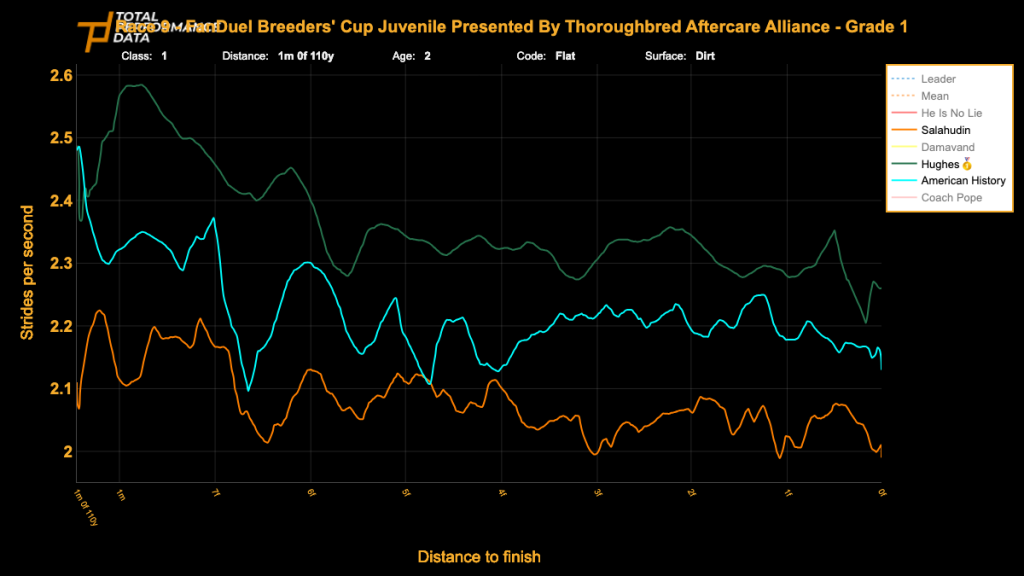 I have included the Stride Frequency Chart for this race because I think it serves as a perfect example of the differences in the cadence profiles of Hughes and the horses that chased him home on Friday. Hughes had a race average stride frequency of 2.36 per second, which stretched out to a peak of 2.57 per second. Both of those numbers were the highest stride frequency figures in the field and his overall race average was above the peak figures recorded for American History (2.35) and Salahudin (2.19). Hughes was able to cruise round within his comfort zone in a race where both of his main rivals had to stretch to their maximum stride frequency figures to keep up. Even with the presence of Coach Pope alongside him, Hughes was able to conserve some energy and over the final 6 furlongs, his average stride frequency dropped by just 0.06 strides per second. A finishing speed of 95.88% points to an evenly run race with an almost identical time to the Juvenile Fillies race won by Emphatic. At a peak average of 24.41 ft, Hughes had the shortest stride in the field and in 5 starts to date, he has yet to stretch out to a peak average beyond 25.05 ft. With a shorter stride, being able to corner around the inside rail was a definite advantage, but he held a lead of just 0.08s at the quarter mile pole and given that his average stride length was over a foot shorter than American History and over 3 feet shorter than his stablemate Salahudin, he did well to assert himself in the final furlong. Having the ability to repel horses on those terms should not be underestimated and whilst the cadence figures would suggest that American History and Salahudin are likely to improve significantly as they step up in trip next season, it would be a mistake to automatically assume that they will improve past Hughes. He had been racing within himself to beat inferior opposition in California, but when he needed to find improvement, he did. Beating a Breeders’ Futurity winner and the winner of the Iroquois should not be underplayed and he was comfortably on top inside the final furlong. He is the current favourite for the Kentucky Derby in the International markets and there is definitely a case to be made for him, but the same can definitely be said for the placed horses too.
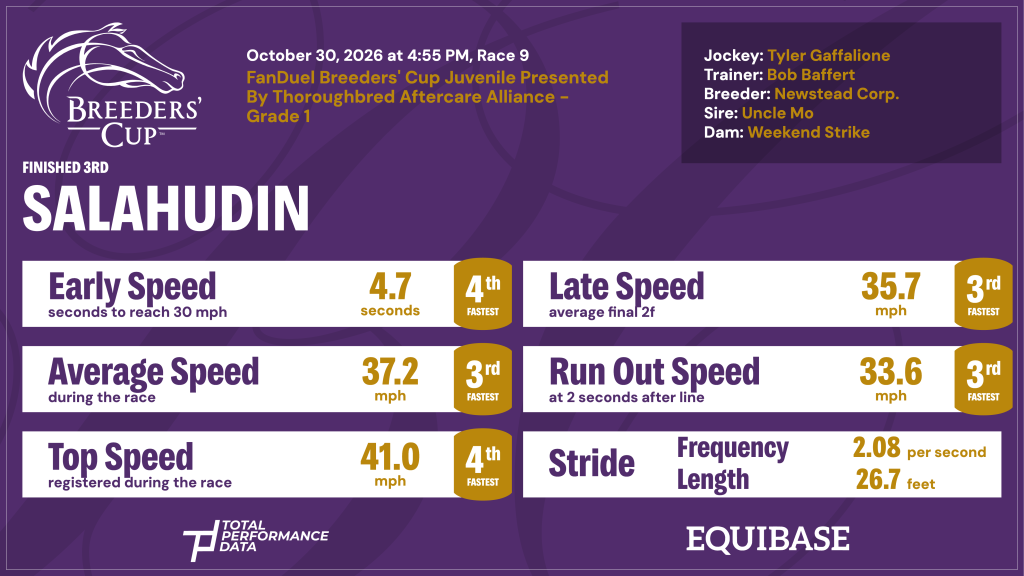 That brings me to Salahudin. This horse is an anomaly in the TPD database. An average stride length of 26.67 ft in the Iroquois Stakes at Churchill Downs came up in our exceptions report. Our data team checked and the figures were right and he produced a similar figure 26.68 ft in the Breeders’ Cup Juvenile. His peak average stride length reached 27.98 ft, which is simply enormous and for a juvenile to be recording data like that, whilst also reaching a top speed figure of 40.97 mph is remarkable. At this stage of his career, he looks a little unfurnished and having raced around the inside rail for the first half of Friday’s race, he was slightly keen going into the first bend. He did settle, but having to force his way around both Damavand and then Coach Pope to make his challenge, all whilst holding American History on his outside was far from ideal. There was a lot for Salahudin to contend with and even allowing for the fact that he was slightly hampered in the home straight, it was probably a step too far at this stage of his career to overcome all of those obstacles. A 3rd placed finish behind his stablemate can only be seen as a positive. Once he matures and grows into his enormous frame, he is going to be a force to be reckoned with at the highest level next year.