



The 157th Deutsches Derby (G1)
Hamburg - 5th July 2026
“It was DARDANOS who delivered a 6th German Derby victory for his trainer Andreas Wohler on Sunday afternoon in the Hamburg sunshine. The 3-year-old by Soldier Hollow raced prominently throughout and once in front, he held off the late challenge of the Henk Grewe trained Chiefland under British rider Cieren Fallon to win by a length”.
Getting out of the stalls and into a prominent position was an important part of this victory. The tight nature of the turns at the Hamburg track mean that it can be difficult to try and make up ground from the rear and the first point to note is that Wladimir Panov had his mount ideally placed by the time they had rounded the first bend and headed into the back straight. An early move by Kairos under Leon Wolff helped to ensure that the pace was a relatively honest one, even as the riders drifted towards the outside of the track along the back straight. Kairos ran a very fine race and held on for 4th place, but once the field turned for home it became apparent that the leading group had the race between them and it was at this point that the race tactics became key.
Firstly I want to point out that I thought Cieren Fallon gave the runner-up a superb ride. Being drawn high in stall 18 was a difficult assignment and having worked hard to get his mount into a prominent position, he must have been delighted to be rounding the first turn in front. Having headed to the wide outside of the course, he must still have been fairly happy even when Kairos came around him to take the lead halfway down the back straight and with a position 3 lengths off the leader with 600m to run he looked to be in the ideal spot. The track is a course that requires a tactical ride and having made the decision that he wanted to come across to the stands side rail, Fallon asked Chiefland to make the move across the track, which he duly did to run alongside that rail for the final 300m. That seemed like a sensible move and his mount certainly wasn’t impeded at any point by doing so, but it did require him to cover slightly more ground than the winner, who was given a more straight forward line across the straight. It’s a fine margin and the ground saved cannot have been more than a few metres, but in a race won by less than 2 lengths, I think it was the difference.
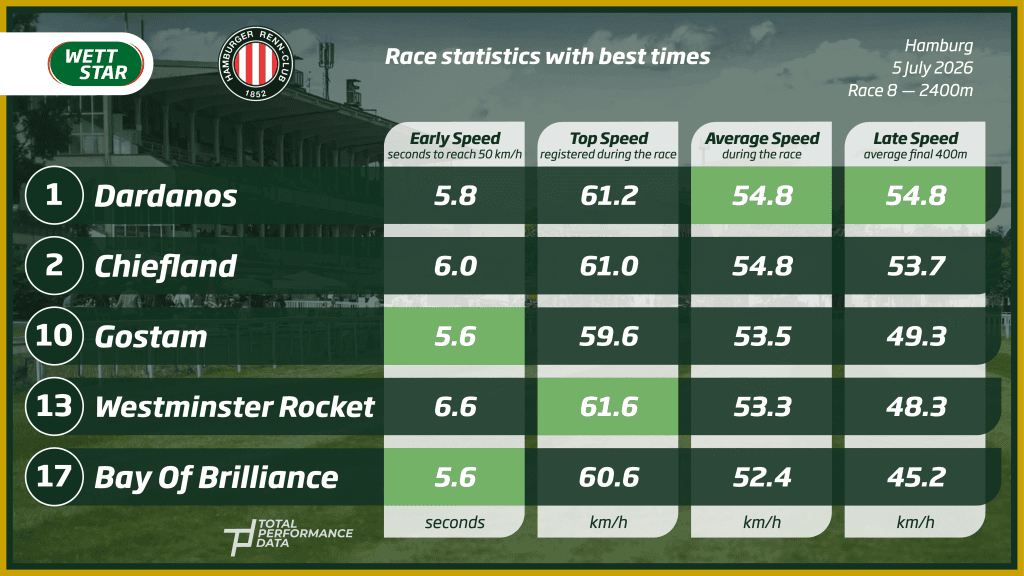
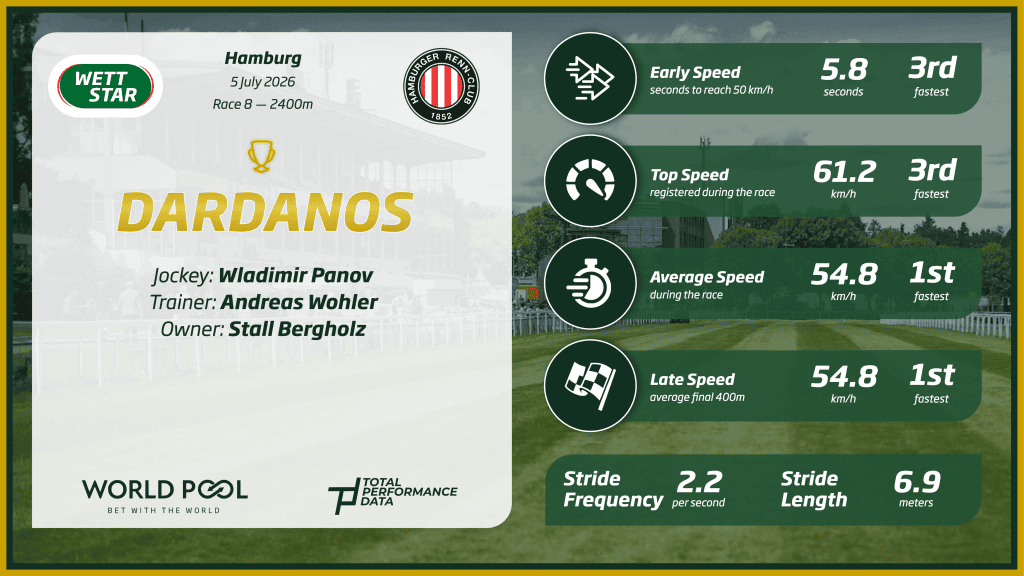
This was a first Group 1 success for Wladimir Panov, who got a brilliant tune out of the son of the now departed Soldier Hollow and as the infographic above shows, he should be commended for delivering his mount at the perfect time with a race best late speed figure of 54.8 km/h, which also matched his race average. If we take the view that he had the slightly faster horse, then the decision not to head across to the stands rail and instead to ride in a diagonal line across the Hamburg straight looks even more significant and once in front, his mount always seemed likely to hold the runner-up. There are some very minimal margins between the in-race metrics data for the first 2, although at an average of 22.78 ft the winner did have the longer stride of the pair. Perhaps more significantly, Dardanos relaxed in the middle part of the race and dropped his average stride frequency down to a minimum figure of 2.12 strides per second, compared to 2.20 and 2.18 sps figures for the 2nd and 3rd. It’s a small point, but in the rough and tumble of a race like this, the ability to conserve some energy for the finish is a crucial point. The placed horses did record better run-out speeds, but having known that he had the race won, that can perhaps be attributed to Panov easing his mount sooner than those who were driven through the line in behind.
Dardanos finished 2nd in the Derby trial in Dortmund last month, but that was a slightly messy race and the winner, Quitos, came with a late burst of speed to pick the pockets of the early leaders along the inside rail. Quitos could only finish 5th in the Derby itself and Dardanos did finish that trial race in a manner that suggested he would improve for the step up to 2,400m. A winning time of 2:39.80 is relatively slow and you have to go back to Weltstar in 2018 to find a slower time in the German Derby, which probably helps to explain why the leading group were able to dominate. Bay of Brilliance (Ralph Beckett) who finished 4th at Epsom, was never really able to get himself on terms once the leaders came across him around the first turn and given the way the race played out, I think it is best to draw a line through this run. That makes it hard to assess where this form sits alongside some of the other Group 1 “Derby” races that we have seen. However, there are reasons for the winners connections to be optimistic about his future prospects, especially with the options open to him in Germany and if he continues to get excellent rides from Wladimir Panov, he should be able to confirm the potential that he has shown so far.