



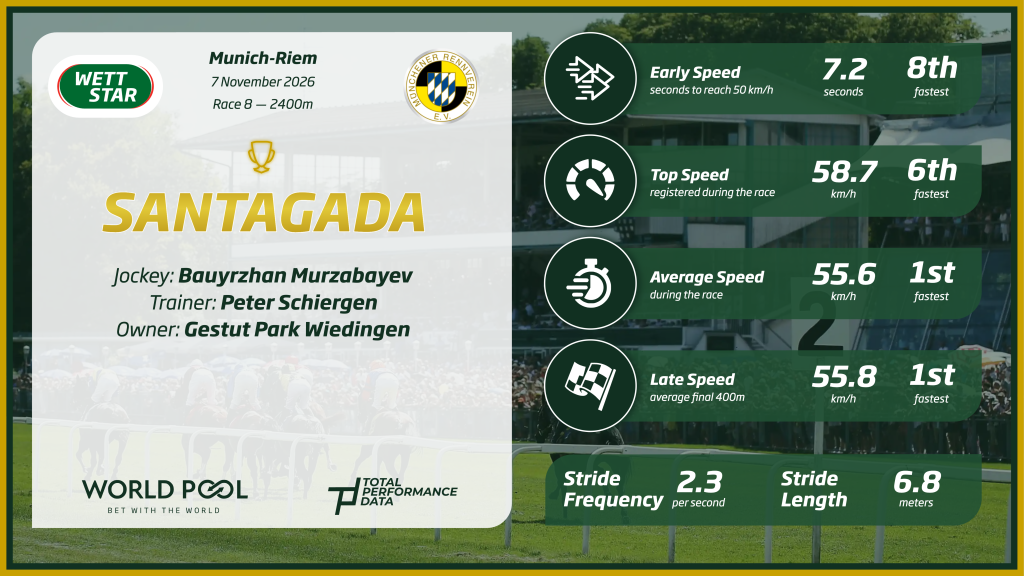
 Santagada is a 4-year-old filly by Soldier Hollow whose dam (Salve Venezia) was a Listed winner over 10 furlongs for Jean-Pierre Carvalho. Bred by Gestut Hony-Hof, this was her third attempt in Group 1 company. The German Oaks (2025) had proven to be a step too far at that stage of her three-year-old career, but in hindsight, her 5th placed finish behind Hotazhell and Wimbledon Hawkeye in the Grosser Dallmayr-Preis Bayerisches Zuchtrennen back in late July was one of the stronger pieces of form on offer. Having been within 3 lengths of the subsequent Irish Champion Stakes winner on that occasion, there is certainly no suggestion that Santagada was winning this race out of turn. Shane Foley had controlled the pace in front aboard Hotazhell that day and although Santagada was less than a second behind that pace for the entire contest, she was unable to get herself on terms to make a serious challenge. However, her penultimate furlong split of 11.20s was quicker than the winners and both Hotazhell and Wimbledon Hawkeye have proven themselves to be capable of repeating this form at the highest level in the interim period. The Grosser Dallmayr-Preis Bayerisches Zuchtrennen was easily the strongest piece of German form on offer throughout 2026. Santagada had built on that form when winning a Group 2 against her own sex at Baden Baden in September when she quickened away inside the final furlong once the gaps appeared in front of her. Whilst it is sometimes easy to say after a horse has won a race, there were plenty of signs from both the data and the form book that Santagada may have been capable of a performance like this going into Saturday’s contest in Munich.
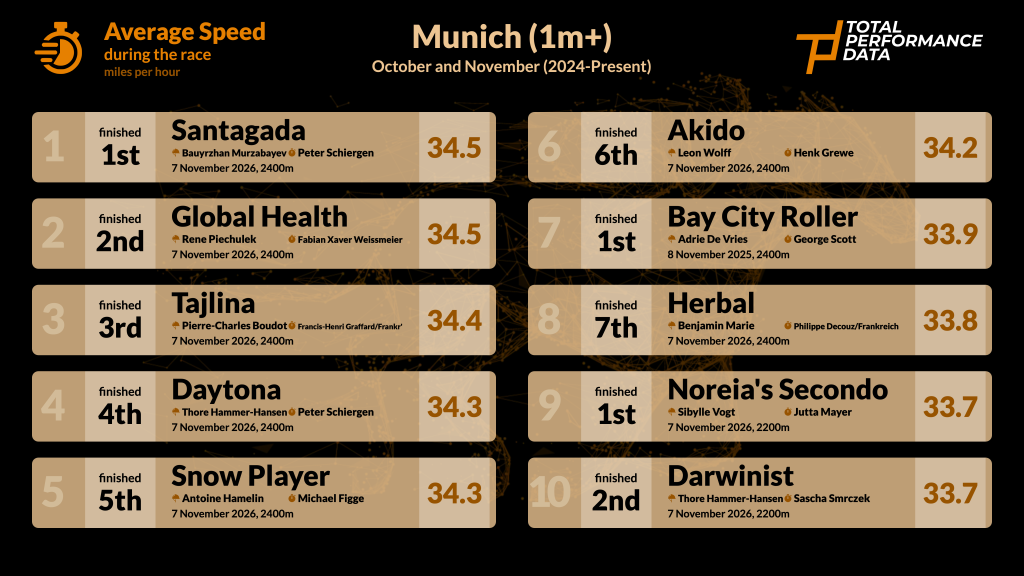 At an average of 6.79m (22.29 ft), Santagada had the shortest stride length figure in the field which was below the expected average for a winner over this course and distance from the TPD database. However, what she lacked in size she more than made up for with speed as she reached a late speed figure of 55.8 km/h and a peak average stride frequency of 2.43 strides per second. This result produced an almost identical set of stride data to those that she produced behind Hotazhell in July, but her closing splits and stride frequency data in the home straight, which were all above her race average figures, would suggest that she was a worthy winner on the day. Having given the runner-up (Global Health) a head start of 0.6s with just three furlongs to run, she did well to close the gap and ultimately won going away with a run-out speed of 50 km/h (ranked 1st). Much like the race in July, the leader had been able to control the pace and Rene Piechulek was able to drop to plus 13s splits as they came out the back straight aboard Global Health. As they headed for home, it became clear that plenty of the principles were not likely to close the gap to the leader and with a lead of 0.4s with a quarter of a mile to run, Global Health looked like the most likely winner at that point. However, Santagada dug in and used her superior stride frequency to record a split of 12.44s for the penultimate furlong, which was the fastest split in the race over the final half a mile. A tactical race on ground no worse than the advertised “Good to Soft” was the perfect set of circumstances for Santagada to exploit, a fact acknowledged by her trainer in his post-race interviews. A winning time of 2:35.41 was more than 3s quicker than the average time for a course and distance winner on the TPD database and the fastest winning time in this race since Seismos won under Andrea Atzeni for Andreas Wohler in 2013. The drier conditions across Europe this year have clearly paid their part in this and as the graphic above shows, in the past 3 years no horse has recorded a faster average speed in Munich during the months of October and November when running beyond a mile. The fact that the first six horses to cross the line in this race also fill the first six places on that graphic, is perhaps a sign of just how much quicker the ground was compared to previous years.