



NYRA Bets Haskell Stakes - Grade 1
Monmouth Park - 18th July 2026
“Lindsay Schultz became the first female trainer to win the Haskell Stakes with Baby Vino and that will no doubt grab the headlines, but underneath that was a battling performance from this son of Vino Rosso. Having taken 5 attempts to break his maiden tag, he has come a long way since winning for the first time at Oaklawn Park on 1st May and giving a Preakness Stakes winner a head start of over half a second, this performance should not be underestimated”.
A sloppy track, a controlled early pace followed by a protracted battle between a pair of battling 3-year-old colts in the Monmouth Park home straight and a yawning gap back to the remainder of the field. I think that would sum up this year’s Haskell Stakes in less than 40 words. The connections of the runner-up may point to the fact that he was conceding weight to the winner and in difficult conditions that may well have been telling, but I think that would also do a dis-service to BABY VINO, who has won his last 3 starts for Lindsay Schultz and who was also having his first try at Grade 1 level.
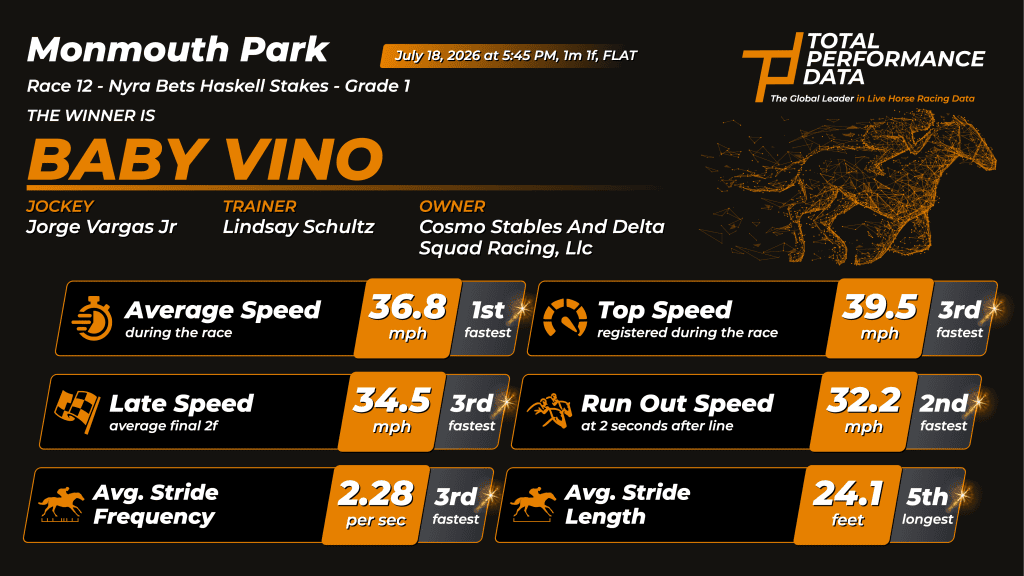
This race followed a similar pattern to some of the best form that we have seen from Napoleon Solo. The son of Liam’s Map has a very fast turn-of-foot when the gates open and all 3 career successes to date have come when he has been able to run a fast opening furlong split. He was the fastest horse out of the gate in the Haskell Stakes too, clocking 12.35s for the opening furlong as he broke well from stall 6 to lead the field into the first turn. His average stride frequency figure ranked only 5th at 2.25 per second for the entire race, but it was quickly up to 2.42 per second for the opening furlong and his ability to get to a high cruising speed in quick fashion is the key to his fast start. He had a largely unpestered lead as a result and was able to control the pace in a race where the winner recorded a finishing speed of 96%. As he showed when winning the Preakness Stakes, on his day and under the right circumstances he is a top-class performer, but there is also perhaps a slight case to be made from the data that his stamina was stretched by the 9 furlong trip on a sloppy track, or at the very least that the winner stayed better than Napoleon Solo. Despite recording the lowest average stride length in the field for the final quarter of a mile, Napoleon Solo was desperately looking for the line and his average stride frequency dropped by twice as much as Baby Vino’s in the home straight, falling from 2.26 per second in furlong 7 to 2.13 in the last. That’s a drop of 6% compared to just 3% from the winner. For comparison, his stride frequency did not drop at all in the final 3 furlongs of the Preakness Stakes at Laurel Park despite that race having a slower finishing speed. It’s a very fine margin, but that’s how Grade 1 races are usually decided and with a difference of 0.11s at the line, Baby Vino’s ability to hold his stride together in the closing stages was the key and he had the better late speed and run-out speed figures of the pair.
Lindsay Schultz became the first female trainer to win the Haskell Stakes with Baby Vino and that will no doubt grab the headlines, but underneath that was a battling performance from this son of Vino Rosso. Having taken 5 attempts to break his maiden tag, he has come a long way since winning for the first time at Oaklawn Park on 1st May and giving a Preakness Stakes winner a head start of over half a second, this performance should not be underestimated. He had already won at Monmouth Park this year when landing the Pegasus Stakes by a wide margin last month. His time that day was the fastest over that extended mile trip this season, but it was still quite hard to equate that to the level of form of those who had contested the triple crown races. However, despite his SP, I wouldn’t want to discount this result entirely as a result influenced by the sloppy conditions and Baby Vino was the fastest horse on the clock for 5 of the 9 furlongs, including 4 of the last 5. Putting his head down bravely in the home straight, he fought his way through along the inside rail and once in front of the runner-up, he seemed unlikely to be beaten. The gap back to Iron Honor in 3rd was 0.7s and whilst Chad Brown’s colt did plug on, it was only in the final furlong that he managed to beat the winner on the clock and the 0.27s that he made up at that stage was far outweighed by the 0.8s that he lost in the preceding 3 furlongs.
Baby Vino has now won a Grade 1 race as a 3-year-old and that is a fantastic result for his connections. Despite Napoleon Solo leaning into him in the home straight, he battled on superbly and there is no obvious reason from the data to suggest that the form would be reversed if the front pair met again. The sloppy track did blunt the speed of Napoleon Solo, who recorded stride frequency and top speed figures that were more than 5% higher at Laurel Park, but Baby Vino showed a great attitude and given the way he finished, there is every reason to think that a stronger pace may have enhanced his chance given the stamina he showed. He has beaten a Preakness winner, but it should be remembered that the main players from the Kentucky Derby did skip that Preakness Stakes and as a result the form is not as strong as it could have been. Lindsay Schultz’s colt will need to improve again next time, but he is going the right way and he seems unlikely to be a 28/1 starting price next time.