



Keeneland Review 10th - 11th April
The spring meeting at Keeneland is well underway. The full set of data from TPD is available via our website, including some very eye-catching debuts from some 2-year-olds trained by Wesley Ward in the last 10 days. This weekend saw several Grade 1 races with clues on offer for the rest of the year and it is those races that I have focussed on, starting with the Maker’s Mark Mile on Friday.
Maker’s Mark Mile Stakes (G1)
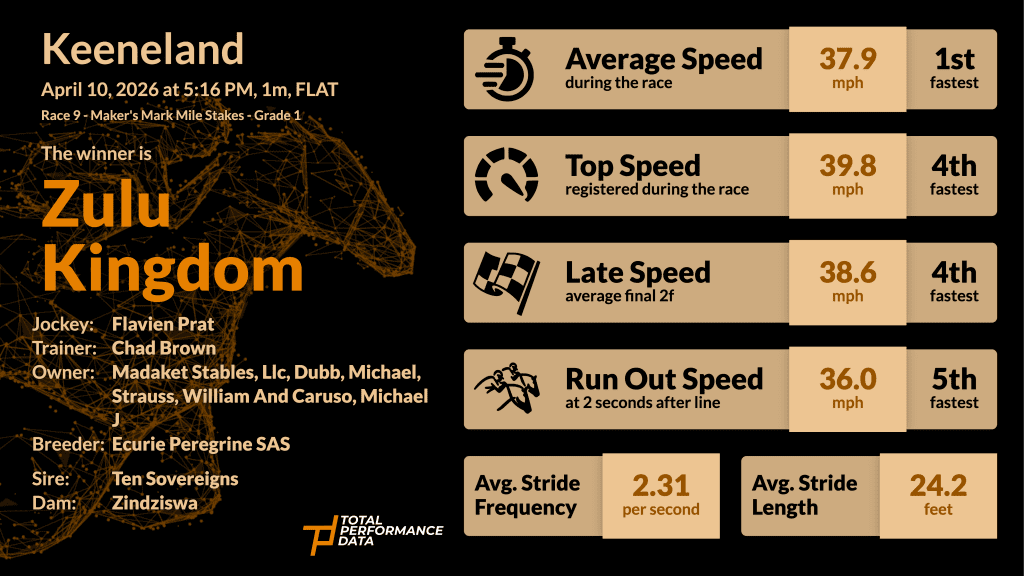
ZULU KINGDOM gave his trainer Chad Brown a 3,000th winner on Friday at Keeneland as he landed the G1 Maker’s Mark Mile and upset the short-priced favourite Notable Speech in the process. I will come to Charlie Appleby’s runner in a moment, but first we should heap some praise on the winner, who has won 7 of his 9 career starts and who controlled this race from the moment the gates opened. Aomori City was presumably in the race to act as the pacemaker for Notable Speech, but he blew the start and despite Richard Mullen’s best efforts, he wasn’t able to get to the front. Instead, Flavien Prat rode a brilliant race, getting Zulu Kingdom to the front with the fastest opening furlong splits (12.38 and 11.71s) to control the pace and more importantly hold the inside rail around the first turn. From there, he held the pace for the next half a mile, keeping his furlong splits between 11.83 and 12.04s before kicking clear off the home bend to win with some authority. A finishing speed of 102.6% for the winner would suggest that Flavien Prat judged this perfectly, especially given that the next 3 horses to chase him home all recorded higher figures, but the damage was done and away from the trouble in behind, this was a relatively comfortable success for Chad Brown to celebrate. A final furlong that ranked 4th (11.75s), a top speed that ranked 4th (39.81 mph) and a run-out speed that ranked 5th (35.97 mph) all suggest that those in behind may have been slightly unlucky, but this was a superb piece of race riding from Flavien Prat and on his first start for over 250 days, Zulu Kingdom would be entitled to improve for this run too.
As for Notable Speech, William Buick’s post-race comments summed it up perfectly. “Well, that was a mess”. The only thing that can be done is to put a line through this run. His pacemaker couldn’t lead and then when they turned for home, Notable Speech ran into a pocket and with no racing room, he simply couldn’t use his turn-of-foot to close on the leader. He had higher late speed and run-out speed figures than the winner and his average stride length figure peaked in the final furlong. These things can happen, especially around a tight turning turf track and having recorded the highest average stride frequency figure in the field at 2.44 per second, I have no doubt that he would have been the fastest horse in the field if he had enjoyed a better run round. If he returns to the UK on a more galloping track, he should return to his best form, but if he races in the US, there will always be the slight risk that something like this could happen. As a result, the form cannot be taken literally when assessing Notable Speech in the future.
Jenny Wiley Stakes (G1)
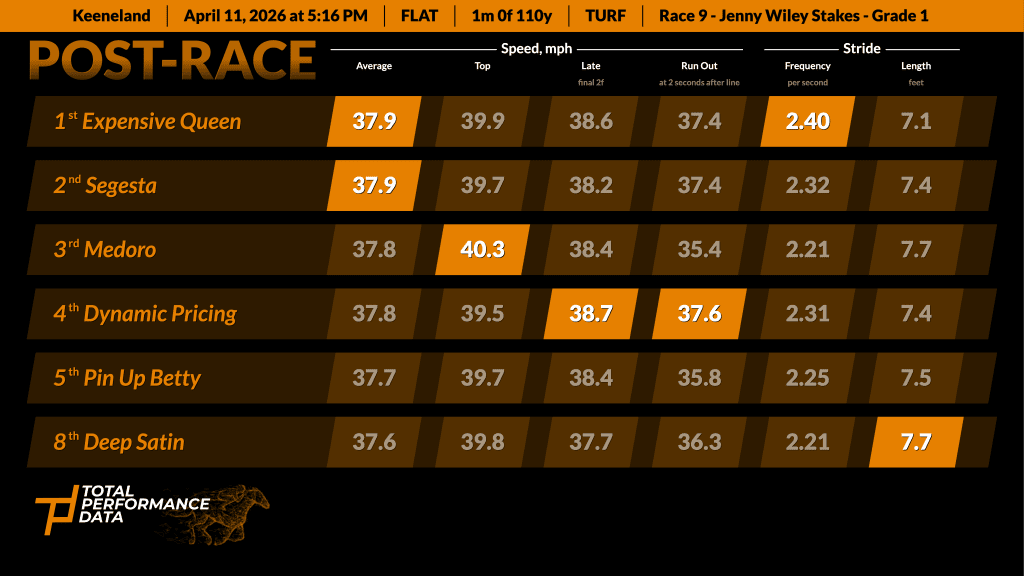
I have included our race summary infographic (above) for this race because the judge wasn’t able to split SEGESTA and EXPENSIVE QUEEN and our data can’t really separate them either. The fact that at the end of this Grade 1 contest over the extended mile, the pair galloped through the line with just 0.11s between them over the final furlong and identical run-out speeds (measured 2s after they crossed the line) at 37.4 mph, is testament to how little there was between the pair. Segesta had won the G1 Matriarch Stakes at Del Mar in November, whilst Expensive Queen completed a hat-trick of wins on Saturday evening after victories at Gulfstream Park and Fair Grounds earlier in the year. The pair of them even have identical career records, with 5 wins from 12 starts each, but if I were to try and find a reason to pick one of them to come out on top in their own right next time, I think that I would rather be with Expensive Queen.
Segesta has done very little wrong and at a peak average of 25.06 ft, she had the much longer stride of the pair (Expensive Queen 23.94 ft) and having broken smartly with opening splits of 6.19 and 11.40s, Flavien Prat had his mount in the ideal position on the hind quarters of the early leader (Aussie Girl). By contrast, despite running the fastest opening split in 6.12s, Luis Saez had Expensive Queen caught in the pocket behind the leaders and had to wait for the gaps to come in the closing stages before he could ask his mount to go and win her race. A finishing speed of 102.8% (Expensive Queen) and 101.7% (Segasta) does suggest that this race was run evenly and so Saez did well to get his mount on terms with Segasta, a fact borne out by the way that Expensive Queen recorded faster closing splits in 11.38 and 11.74s, recording the quicker late speed figure of the pair at 38.6 mph. In normal circumstances, a look at the late speed data would suggest that Expensive Queen was the unlucky “winner” and that with a clear run, she would have won in her own right. That may be true, but having watched the replay for this race a couple of times, I can’t help but feel that Segasta idled in front and appeared to pull herself up, at least partially, when Flavien Prat asked her to stretch. Both her average stride length and stride frequency figures increased into the penultimate furlong, only to decrease again when she hit the front. Expensive Queen ran her down and was the faster horse in the closing stages, but given that Segesta quickened when she was joined and recorded an identical run-out speed, we can make the assumption from the data that she had something left in the tank. Having watched back a few of her races at the end of 2025, there is perhaps a case to be made that she did something similar then too, most notably when a close 2nd in the First Lady Stakes at Keeneland in October. She is clearly a very talented filly and her Grade 1 victory at Del Mar in November was very impressive, but if given the opportunity, there is just a slight suspicion from the data and the video replay that she may prefer to be played as late as possible.
Expensive Queen struggled during her time in the UK with Kevin Ryan and James Tate, reaching a peak OR of just 83. However, she has turned over a new leaf since moving to the US with Brendan Walsh and has now won 4 of her 5 starts across the Atlantic. She was 4th on her first try in Grade 1 company in the Gamely Stakes at Santa Anita last May, but the winner (Be Your Best) controlled that race by setting fast early fractions. Expensive Queen recorded a quicker final furlong split and given that the race came just a month after her US debut I think we can forgive that. She is unbeaten since and her compact stride and turn-of-foot, which includes a race best average stride frequency of 2.4 per second on Saturday, should mean that she is ideally suited to turf races in the US, where the tight nature of the tracks suits fillies that can corner well and then quicken through the gaps when they come. She is the more progressive of the pair of winners on Saturday and I would expect her to confirm the theory next time.
Stonestreet Lexington Stakes (G3)
There was a shock result in the 3-year-old race as TRENDSETTER caused a 32-1 shock to win the Lexington Stakes under Kazushi Kimura for trainer Ben Colebrook. Having been beaten in each of his last 5 starts in Stakes company, his starting price did look to be about right, but the data does suggest that this wasn’t a complete fluke and on the day, Trendsetter was the best horse. Kazushi Kimura was certainly helped by having the leaders in front of him setting a strong pace as they battled for the lead. Ezum, The Hell We Did and Corona de Oro were all ridden aggressively and each of them reached the 6 furlong pole in under 30.5s. That resulted in the 2nd and 3rd placed horses recording finishing speeds of 94.6 and 94% respectively and as a result, the race was set up for a horse to close and take advantage of the drop in pace and that horse was Trendsetter.
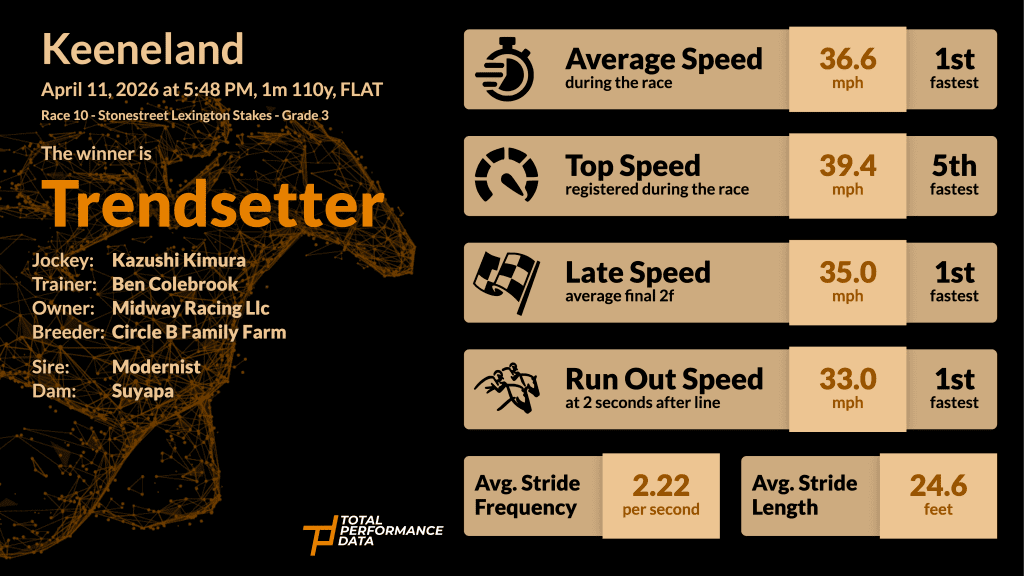
Trendsetter became the first graded winner for his sire Modernist and added to a very successful Keeneland meeting for his trainer after he saddled Percy’s Bar to win the G1 Central Bank Ashland Stakes on Good Friday. Trendsetter was the fastest horse in 4 of the last 5 furlongs and came home with a race best late speed figure of 35.05 mph (next best The Hell We Did 34.25 mph) as he powered on to win by over 2 lengths, hitting the line strongly with a run-out speed of 32.9 mph. He did get the perfect setup and having covered the opening half a mile in 47s, he had more left in the tank than most of his rivals when they began to turn for home, but I liked the fact that he was the only horse in the field who was able to increase his stride frequency in the latter part of the race. On the basis that he finished the race nicely and showed that he does have the required stamina for a well-run race around 2 turns, recording the longest average stride length in the field at 24.58 ft, it is not impossible to think that he could win at this level in the future too. A winning time of 1:44.51 ranks 8th of the last 10 runnings of the Lexington Stakes and that is probably a fair reflection of the level of form that the winner has reached. He earned 20 points on the Road to the Kentucky Derby by winning this race, but that is unlikely to get him a run and the overall level of form that he has shown so far would suggest that Trendsetter is some way below the required level for a Grade 1 contest, even if this was a career best performance. There have undoubtedly been stronger 3-year-old races in recent weeks, but Trendsetter did at least show some significant improvement for Ben Colebrook and if carefully campaigned, he should be able to find further races for this son of Modernist that will produce similar circumstances.