



WILLIAM HILL OAKS TRIAL FILLIES' STAKES
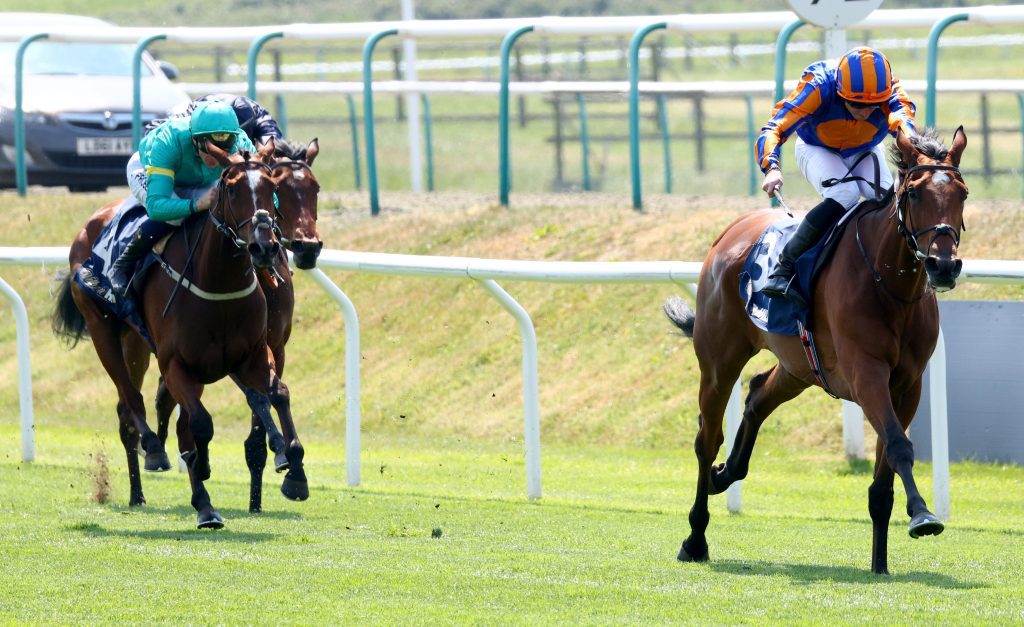
I will come to the Godolphin runners later on but this race was all about CAMEO, who ran as close to the perfect Oaks Trial as could have been imagined. The strength of this form is certainly open to question. Prizeland (2nd) is a nice filly, but she came into this race with an official rating of 85 and seems unlikely to be a classic contender. Bloom (3rd) is a Cork maiden winner and has run well in a pair of trial races, but she does seem to be relatively one paced and despite having the run of this race in front, she was readily beaten by 7 lengths and was 1.39s slower than her stablemate over the final 3 furlongs. Romantic Symphony (4th) ran below her best, as plenty of horses from Charlie Appleby’s stable have in the last 14 days and Amora Queen (5th) struggled to stay with the field when the pace lifted and weakened in the straight. It’s not a great start, but I have tried to approach this race from a different angle. If we simply looked at the performance of Cameo as if she was the only horse that went to post, our data does offer much more optimism for her chances at Epsom.
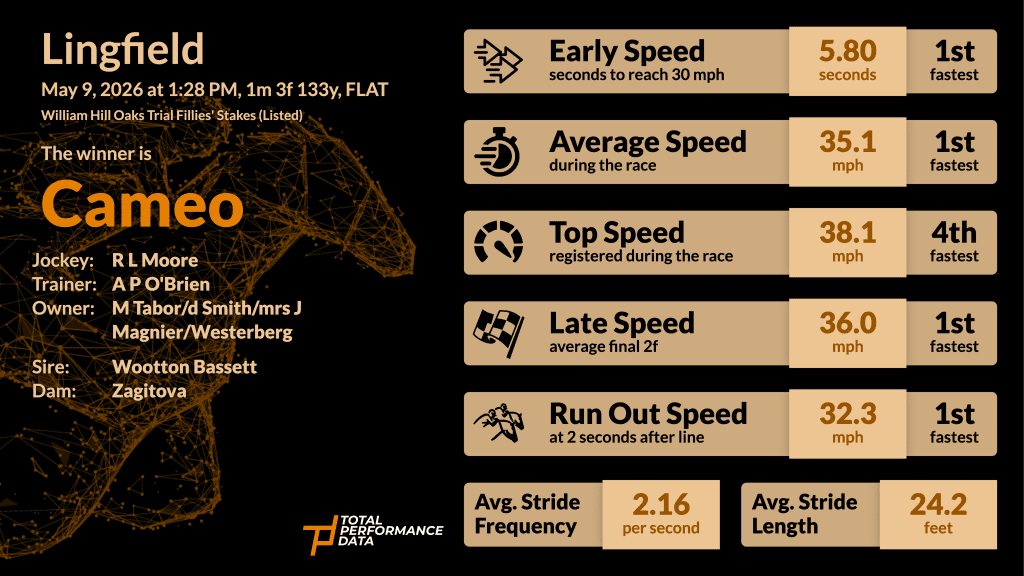
When the gates opened, Ryan Moore was keen to get her out and across to the inside rail. He did so by getting Cameo to 30 mph in just 5.8s, the fastest early speed figure in the field as she recorded 10.59s for the opening furlong. That’s the first tick in the Epsom box, early speed to get out of the stalls and into a decent position. Cameo recorded an average stride frequency figure of 2.16 strides per second over the entire race, but the stride frequency data becomes more interesting in the middle part of the contest. Between the 4th and 9th furlong, Cameo recorded average stride frequencies between 2.08 and 2.12 strides per second, the lowest figures in the field for each of those furlongs. In part that’s because she was the longest striding filly in the field, recording a race average stride length of 24.19 ft, meaning that she needed to use less energy to maintain the gallop. More significantly, the stride frequency data suggests that she is able to relax and conserve her energy before the pace begins to lift. Cameo recorded a variation of just 0.04 strides per second for those mid-race furlongs compared to variations of 0.08 and 0.09 strides from the 2nd and 3rd. That might seem like a minor difference and over the course of just a few yards it would be, but in a race run over an extended 11 furlong trip, it begins to add up. We can say confidently that Cameo was the most efficient runner in the field and she required just 2 furlongs above her race average SF figure in the latter part of the race to quicken clear. Cameo was the fastest horse in each of the final 3 furlongs and was able to pull clear even with Ryan Moore easing her in the final few strides. Her winning time of 2:28.80 was 0.51s slower than the TPD expected time for the grade, but a combination of a small field and a lack of competition to take her into the final furlong would be enough for me to think that Cameo could have run a faster time under different circumstances. She was within 2% of the previously recorded averages for a race in this grade over the course and distance and should head to Epsom perfectly equipped to handle the track based on the evidence we have. The only slight concern I would raise is the fact that she did show a tendency to lean away from the pro-cush, shifting to her left when it was used in the closing stages, but at Epsom that is unlikely to be a great inconvenience unless the ground is uncharacteristically soft, which seems very unlikely at this stage. She is clearly improving and at the time of writing, Cameo is between 10 and 12-1 for the Oaks, which is more than fair based on the performance and data that she produced at Lingfield on Saturday afternoon.
WILLIAM HILL LINGFIELD DERBY TRIAL STAKES
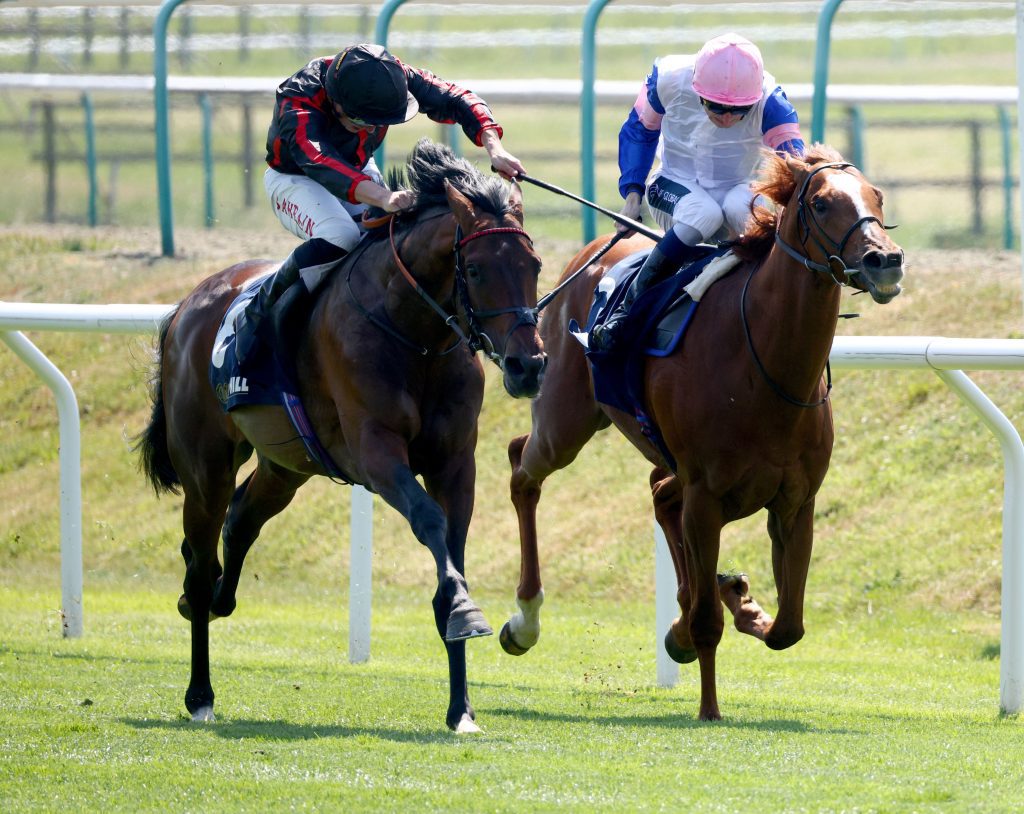
Much like the Fillies race 30 minutes earlier, there were plenty of runners in this race who simply weren’t good enough. Isaac Newton (5th) had the highest average stride frequency figure in the field for 10 of the 12 furlong splits and used far too much energy to last the trip as a result. Balzac (3rd) and A Taste of Glory (6th) had every chance but simply couldn’t match the late speed of the winner and both look more likely to head to handicaps in time rather than Group 1 company. Now let’s talk about the front pair. They are the horses to take from this race and a yawning gap of 6 lengths back to the rest would confirm the view from the data that this pair were a class apart. If we simply examine the last 3 furlongs, it is very hard to separate them. There was just 0.09s between the pair on the clock over those final furlong splits and their late speed figures could be separated by just 0.05 mph. Bay of Brilliance actually came out slightly ahead with his late speed and if I was being particularly harsh, I might suggest that he had every chance and wasn’t as willing as the winner to battle all the way to the line. That is a harsh view and given that this was his first start since October and more significantly his first run outside of maiden and novice company we have to give him a pass for what was otherwise a superb performance. However, I do believe that Maltese Cross was the stronger stayer of the pair, even if he did have the benefit of a recent run at Newbury on his side.
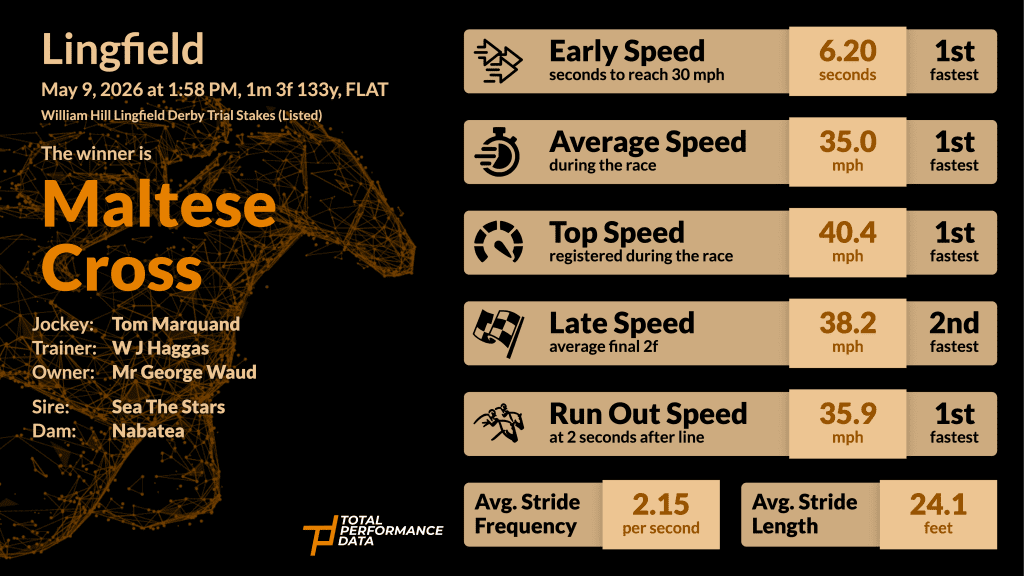
Maltese Cross is a long striding son of Sea the Stars who recorded a peak average stride length of 26.20 ft. He reached that peak at the top of the home straight. Perhaps more significantly, in the final 2 furlongs his average stride length maintained an average of 25.3 ft at an average of 2.24 strides per second for the final quarter of a mile. He maintained his stride length figure at a time when Bay of Brilliance dropped his from 25.6 ft in the penultimate furlong to 24.54 ft in the last. It’s a small point, but that figure alongside the fact that Maltese Cross recorded the fastest run-out speed in the field (35.88 mph) would suggest that he is likely to be the stronger stayer of the pair. Maltese Cross was certainly much closer to a “typical” winner over this course and distance at this level (24.1 ft average stride length, 2.19 average stride frequency per second). A long stride is not a guarantee to success at Epsom by any means, but if the horse gets a clear run into the straight it can certainly help. We have seen several impressive trial winners in the last week, albeit in small field races and if pushed I would probably argue the case that the Chester trial winners achieved slightly more, but there isn’t much in it and one thing we can be relatively sure of is that Maltese Cross will stay the distance. Much like Cameo he relaxed mid-race and dropped his average stride frequency down to 2.03 per second in the 7th furlong compared to a race average of 2.15 strides per second. Maltese Cross did very little wrong at Lingfield on Saturday and goes to Epsom with an each-way chance as a result.
At the time of writing (Sunday morning in my favourite coffee shop if you must know), Charlie Appleby has a record of 22 runners, 0 winners and 6 places in the last 14 days. Compare that to May 2025, where he recorded a strike rate 27.7% and it’s obvious to see that things aren’t quite right. For that reason, I do think that the performances of both Romantic Symphony and Maho Bay in these trial races need to have a line drawn through them. I’m not trying to argue the case that either of them are likely to win at Epsom, if indeed they line up, but the sectional data does show that both of them have the required level of ability, but that neither were able to finish their races. I know that’s obvious from the video replays before anyone feels the need to point that out to me, but the data from TPD shows that both of them were competitive with the respective winners of the trial races, at least to a certain point. Maho Bay recorded a top speed of 39.98 mph (ranked 3rd) and was the fastest horse in the 9th furlong of the race (11.35s), whilst Romantic Symphony recorded a top speed of 38.38 mph, which was faster than both Cameo and Bloom. Each of these races developed later, with the pace lifting once the horses began the descent into the straight and from that point, both of Charlie Appleby’s runners began to struggle as they failed to maintain a raised stride frequency. If we take it as a working hypothesis that there is an issue in the yard, then both need to be judged on their earlier form once the signs are that the team are returning to form.