



Review: Grey Dawning continues his love affair with the Betfair Chase
By Adam Mills
We switch back to Jumps racing for this week’s round up and the only place to start is with Grey Dawning’s victory in the Betfair Chase for the Skeltons. This was essentially the “Gold Cup” for Grey Dawning and his connections and the likeable grey proved once again that the extended 3 miles at Haydock suits perfectly as he ran out a relatively comfortable winner. A winning time of 6:32.75 was over 8s outside the TPD expected time for the race on the basis of “good” ground and a steady pace, coupled with a finishing speed of 105.19% from the winner, left this race at the mercy of Grey Dawning and he duly obliged. Nursed into the race by Harry Skelton, he always seemed to be in complete control, even when Jagwar was briefly looking to assert after jumping the last. When asked to quicken again, Grey Dawning found more to come home in 15.37s for the final furlong, 0.81s quicker than his rival. Dan Skelton implied that the Ryanair will now be his target for the Spring and given what happened in last year’s Gold Cup that would look to be the most obvious of the festival races for the 9-year-old. He is a top class performer and good value for his official rating of 166, but he has been to Cheltenham on four occasions and only come out on top once, albeit in the now abandoned Grade 1 Turners Novice’s Chase. He came out on top for each of our in-race speed metrics on Saturday afternoon, recording a top speed figure of 33.29 mph and is clearly one of the main contenders for the Ryanair at this stage. However, the three horses that chased him home on Saturday have official ratings of 155, 153 and 150 and two of them ran a faster final furlong than Grey Dawning. Even allowing for the fact that Harry Skelton had the race completely in the bag by that stage, Grey Dawning is likely to need to find more in March after jumping the last.
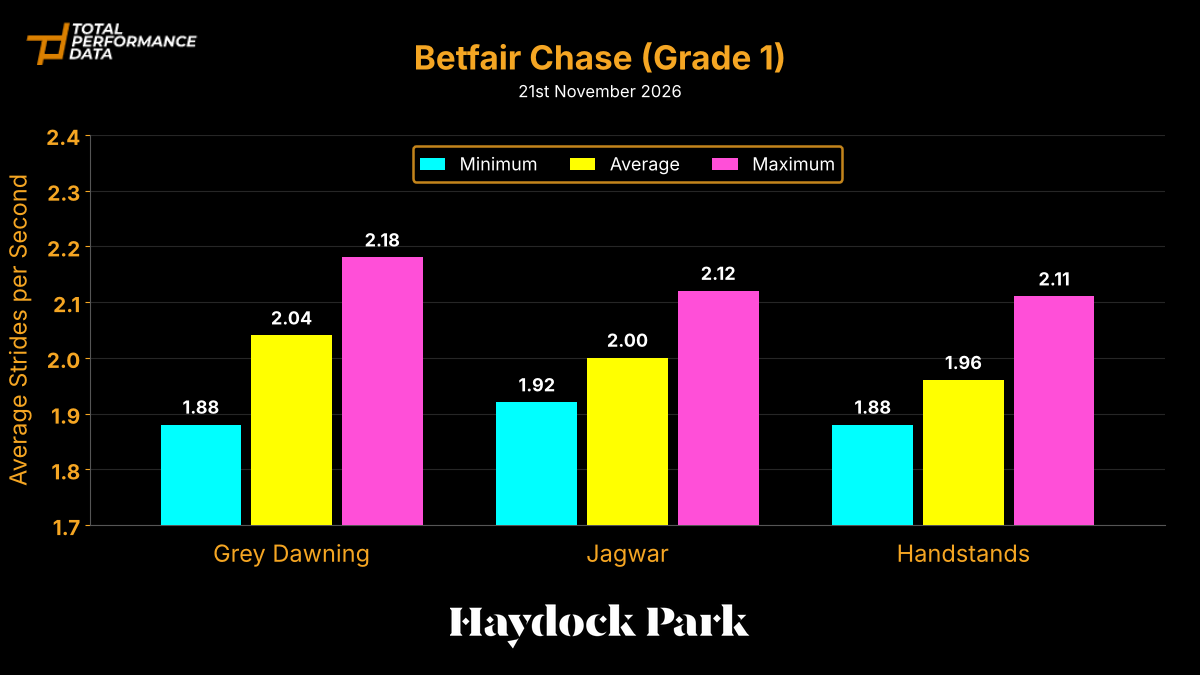
Harry Cobden gave Jagwar an excellent ride and the 7-year-old seemed to take the step up in class in his stride. He jumped fluently in front, putting in the best round of jumping in the field with an average speed loss of 9.9%. Racing prominently seemed to suit and having jumped out to his left in the closing stages, he did concede ground to Grey Dawning at each fence in the straight, even though the ground lost would not have been enough to affect the overall result. He was no match for the winner after the last and perhaps just lacked the turn-of-foot to hold on when it mattered. At an average of 2.0 strides per second, he was closely matched with Grey Dawning (2.04 per second) for stride frequency. However, the winner had a much greater variance between his minimum and maximum figures, as shown by our graphic above. It may seem like a minor variance of less than 0.1 strides per second, but over the course of a race, having to put in extra strides and use more energy in the process can be the difference between winning and losing, especially at this level. Grey Dawning raced more efficiently and then had the necessary change of gears to seal the deal when it mattered. Jagwar still produced a superb effort and his stride data might suggest that a stronger test would suit. He came into this race with a mark of 155 and would likely be the top weight in any contest were he to return to handicapping, so the graded route would seem likely the most obvious plan for now, with another shot at the Grand National as the ultimate aim.
Hexham – 18th November
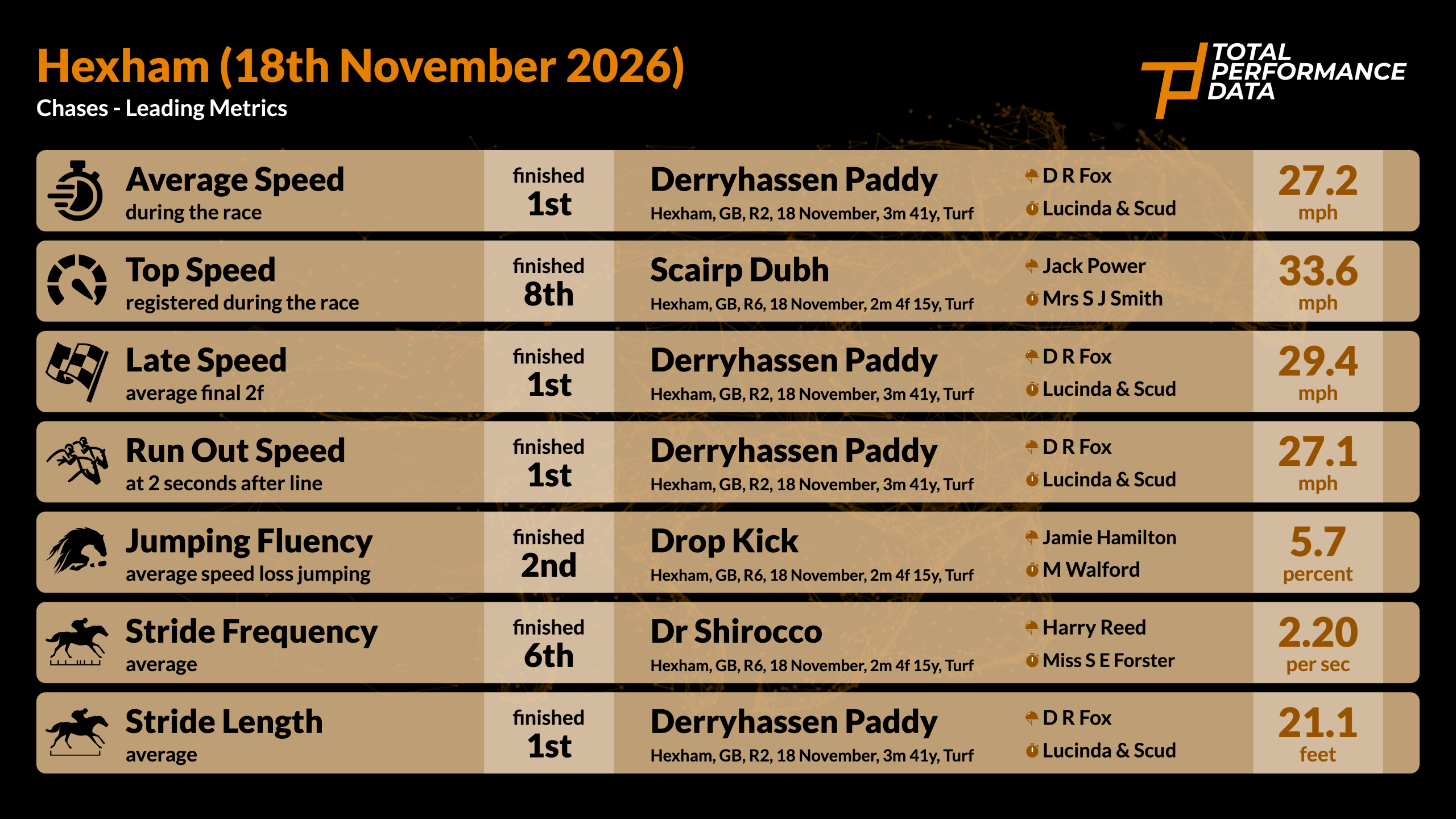
There were also a couple of very significant Beginners’ Chases last week. I’ll start with the victory of Derryhassen Paddy at Hexham. He made virtually every yard under Derek Fox in a time that was around 6s under the TPD Expected time figure for the race. Jumping fluently in the main, he lost an average of 10.1% of his speed over his obstacles which almost exactly matches the course average, but interestingly that figure decreased to only 6.4% in the latter part of the contest when the pace lifted. He found over 1.5s on the runner-up (Julius des Pictons) after jumping the last, though we must also acknowledge that he did have the benefit of a recent run in his favour. There were 17 horses who completed the chase course at Hexham on Wednesday and of those, Derryhassen Paddy had the best Average, Late and Run-Out Speed figures. That’s probably to be expected from a horse who was 3rd in the Albert Bartlett behind Jasmin de Vaux in 2025, but he showed himself to be nimble enough to handle the uniquely undulating test that Hexham presents. Having missed the vast majority of last season, he has some time to make up for, but having shown promise on his return at Cheltenham in October, this was another step in the right direction. We can’t really be sure how fit Julius des Pictons was after such a long absence and he also emerged from this race with plenty of credit, having matched the winner before tiring after the climb to the home straight. Fishery Lane (3rd) is now 0 from 8 over fences and despite being given plenty of opportunities by Willie Mullins in Ireland, he has only a maiden hurdle win on his CV. A mark of 131 is fair at best on the balance of his form and he may need a little help from the handicapper before he gets off the mark for Dan Skelton.
Ffos Las – 18th November

On to Ffos Las a little over half an hour later. Hopefully Old Park Star is over his issues sooner rather than later and it is a real shame that we were perhaps robbed of what looked to be a superb early season match up. Sober Glory set some even fractions and came home in a winning time that was 0.48s outside of the TPD Expected time at a finishing speed of 104.7%. The concern for me with this performance was not the pace, but Sober Glory’s jumping. I appreciate that there is a lot of data on the chart above, but having taken all of the horses who competed in the Chases at Ffos Las on Wednesday, an overall speed loss of 12.7% from Sober Glory, ranked 4th of 4 in the contest, would ring some alarm bells. He jumped out to his right and the average 14.8% of his speed lost over the final few obstacles was more than the eased down Old Park Star (13.6%). He ran a huge race in the Supreme last season and remains an exciting prospect, but when we compared his jumping on Wednesday to the remainder of the card, it raised a few doubts. It was his first time jumping fences in public and when Old Park Star failed to pick up, it left him in front with nothing but the fences ahead of him. To a certain degree, the jumping fluency scores of the other two runners needed to be adjusted given that they were ridden with another day in mind, but Sober Glory will need to jump much better if he is to win an Arkle, a race for which he is now as short as 4/1.
I could leave this race on that point, but with all the hype about the horses at the head of the market, the run of Carlenrig for Dan and Harry Skelton has slipped slightly under the radar. He won the G2 Albert Bartlett Trial at Cheltenham last December and was still in with a chance when came down in the home straight in the River Don at Doncaster. Having been ridden very patiently, he was over 3s behind Sober Glory with a quarter of a mile to run. On his first run of the season behind some proven Grade 1 performers, this was an understandably patient ride, but I am particularly interested in the way that he finished his race, recording the fastest final furlong split in the field and a run-out speed of 31.5 mph, quicker than his late speed over the final two furlongs. That would suggest that there is a lot more to come, as would the fact that his average stride length figure reached its race peak inside the final furlong. He missed the Spring festivals last season, but he had shown a decent level of form prior to coming down at Doncaster and having been ridden accordingly on Wednesday, he needs to be added to the tracker with a bigger day in mind.