



Royal Ascot 2026 - Key Data Talking Points
I have a new strategy for Royal Ascot this year. The plan is to focus on the proven performers in the Group 1 races and then hope to be on the right side of the draw with the 2-year-olds and the handicappers. I’ll come to the handicaps next week, but for now I have started by looking at some of the big clashes next week, particularly the 3-year-old races and have put together a summary of some of the key data points below.
St James’s Palace Stakes (G1)
This race seemed like the most obvious place to start. The clash between Bow Echo and Gstaad, the 1,2 from the 2,000 Guineas at Newmarket, is likely to be one of the races of the week. We also have the French 2,000 Guineas winner Rayif and the exciting Talk of New York. Both of them ran the fastest final furlong in the field on their latest starts, but I have been able to pick too many holes in their form to be able to make a really strong case for what would be at least a slight upset in the market.
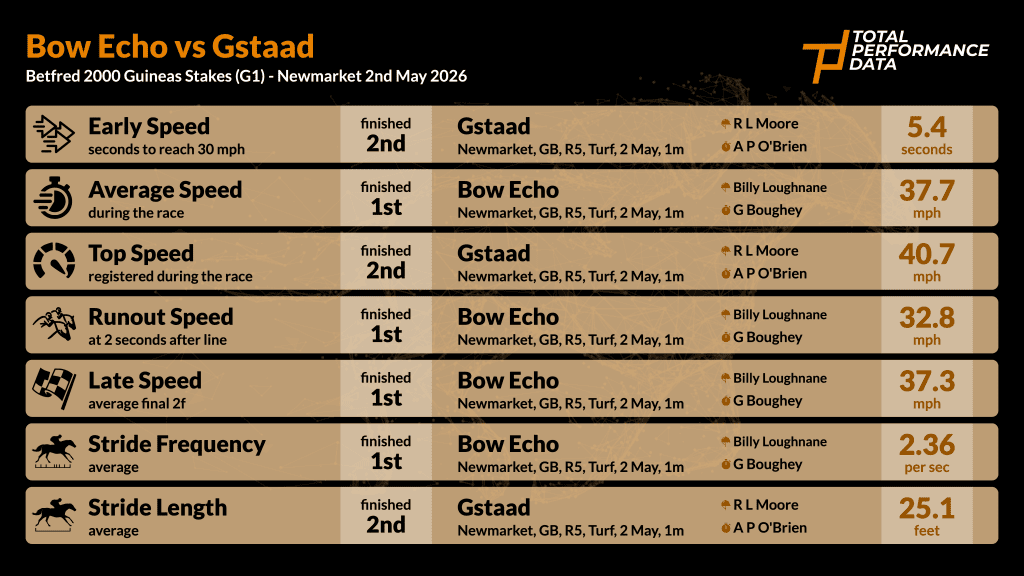
I’ll start with some of the expected average figures. The St James’s Palace Stakes winner has reached an average speed figure of 35.7 mph, rising to an average late speed figure of 37.7 mph. The stride averages over this course and distance comes out at 23 ft and 2.35 strides per second as overall race average figures. So if we take that as the base line, then both the main players come out with a longer stride and Bow Echo has also achieved an average stride frequency of 2.36 per second in the 2,000 Guineas. Gstaad had the better top speed figure of the pair at Newmarket and he backed that up when recording a similar figure in the Irish 2,000 Guineas at the Curragh, but he has work to do with Bow Echo. If we take the sectional times as a working example from Newmarket, Bow Echo was the faster of the pair in each of the final 6 furlong splits in the 2,000 Guineas. In fact he was 0.83s, around 5-6 lengths faster over that section of the race. Aidan O’Brien’s colt may well have improved for the benefit of that run when winning in Ireland, but Bow Echo would be equally entitled to improve and I don’t really buy this idea that Bow Echo was trained to win the Guineas and as a result there is no more improvement to come. He’s won all 4 starts to date and we really don’t know where his ceiling may be. In the last 20 years, only Kameko (2020) and Cockney Rebel (2007) have run faster winning times in the Guineas and I’d have to make the case that his speed will be suited by going around the bend at Ascot just as much. Gstaad could also improve, but he will need to. At the time of writing, there is better than even money available that an unbeaten 3-year-old classic winner will uphold a winning margin of nearly 3 lengths and the data would suggest that Bow Echo is the better option as a result.
Prince Of Wales’s Stakes (G1)
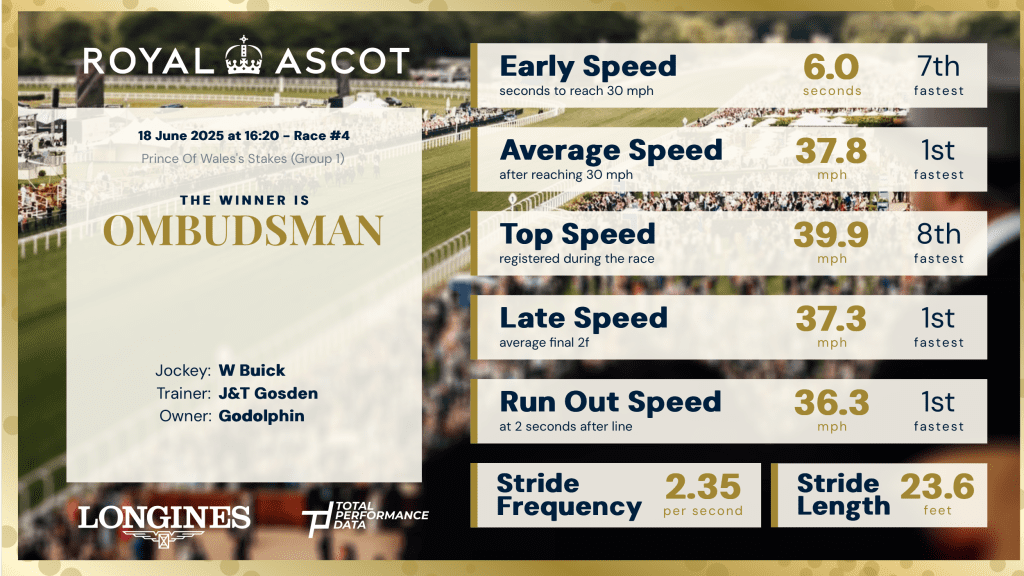
The 2025 renewal of this race was the fastest running of this race in over a decade. Ombudsman was a worthy winner on the day and he got a brilliant ride from William Buick. In a race where there was an extremely rare lapse of judgement from Ryan Moore, as both Los Angeles and Continuous took less than 49s to cover the opening half a mile and didn’t make it up the hill as a result, it helped to set the race up and it is no coincidence that the first 4 to cross the line were the last 4 at halfway. Ombudsman had to switch a couple of times but when the gaps eventually came, he went through it readily to win comfortably with a race best run-out speed of 36.33 mph. That was and in my opinion remains, his career best performance, but he did go on to win a Juddmonte International and finish 2nd to Calandagan in the Champion Stakes afterwards to confirm his status as an elite 10 furlong performer.. His Ascot record is excellent and he sets a very high standard for this field to aim at, but can he beat the Arc winner?
He did finish ahead of Daryz in the Juddmonte International, but the somewhat bizarre nature of that race, with the front running Birr Castle going from pacemaker to clear leader after a couple of furlongs, means I am more than happy to put a line through that run, even if it does mean that Daryz is yet to prove himself outside of Paris. Since that race, Daryz has improved significantly and has added both the Prix Ganay and the Prix D’Ispahan to his Prix de L’Arc de Triomphe success. Both of those G1 successes this season have come in the typically run French racing style, where the pace develops later and it turns into a sprint finish, but having dropped back in trip, Daryz has proved that he has plenty of versatility. In the Prix Ganay, he recorded closing sectional splits of 10.51 and 10.58s. In the Prix D’Ispahan he finished with furlong splits of 10.68 and 11.02s. I’ve looked back through our records for Ombudsman and I can’t find a race where he has ever run as fast as Daryz did in the Prix Ganay. Daryz has never run at Ascot and Paris Longchamp certainly favours a top class horse that can finish with that kind of turn-of-foot, but the data supports the theory that he is a 10 furlong horse who has won an Arc, rather than a typical middle-distance performer dropping back.
Coronation Stakes (G1)
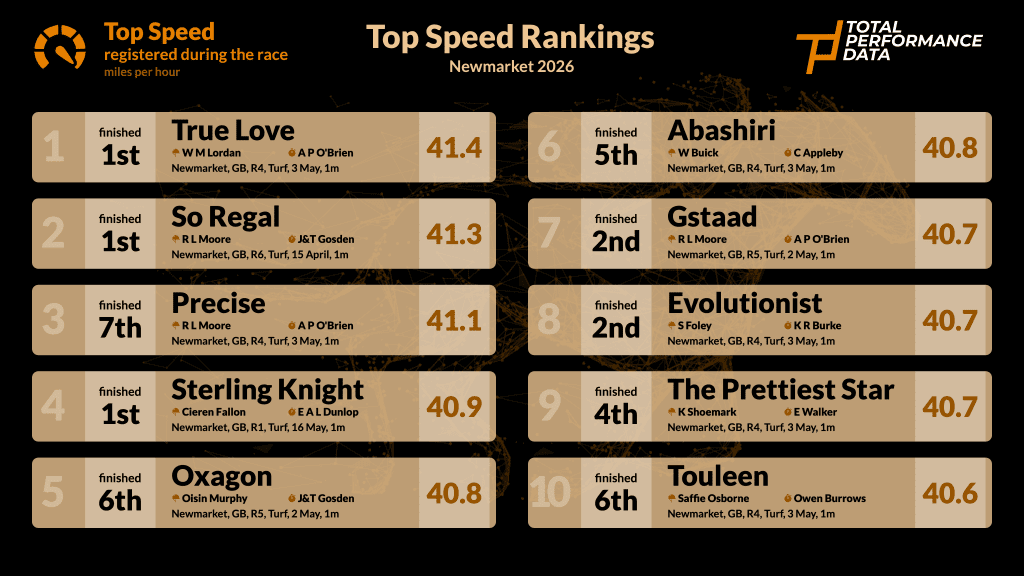
Whenever you use words like “bombproof” to describe a favourite, it can leave you open to all kinds of criticism when they inevitably get turned over at short odds. However, if there is such a thing as a certainty next week, it is surely Precise in the Coronation Stakes. She finished behind True Love in the 1,000 Guineas, but as you can see from our graphic above, her top speed figure of 41.1 mph still ranked in the top 3 figures of all the horses to have run over a mile at Newmarket so far this year. On her first start of the season, racing on the far side of the track (which didn’t appear to be the best place to be), she recorded a time of 44.92s for furlongs 3 to 6. By comparison, True Love ran a time of 45.12s to cover the same 4 furlongs. Precise raced on the far side, whereas the winner and the 3rd raced towards the stands side of the course and the runner-up raced down the centre having been prominent throughout. On her first start of the season, this was a huge effort by Precise and her stride frequency dropped from a race peak average of 2.4 stride per second (6th furlong) to a race low of 2.25 per second in the space of a furlong. That suggested to me that she clearly needed the run and she readily reversed the form with her stablemate in the Irish 1,000 Guineas at the end of May, a race where she ran the fastest final 2 furlong splits and recorded the highest top speed figure. On both starts this season, she has recorded a top speed figure above the average figure recorded for a winner of the Coronation Stakes and she should be hard to beat if running her race.
Commonwealth Cup (G1)
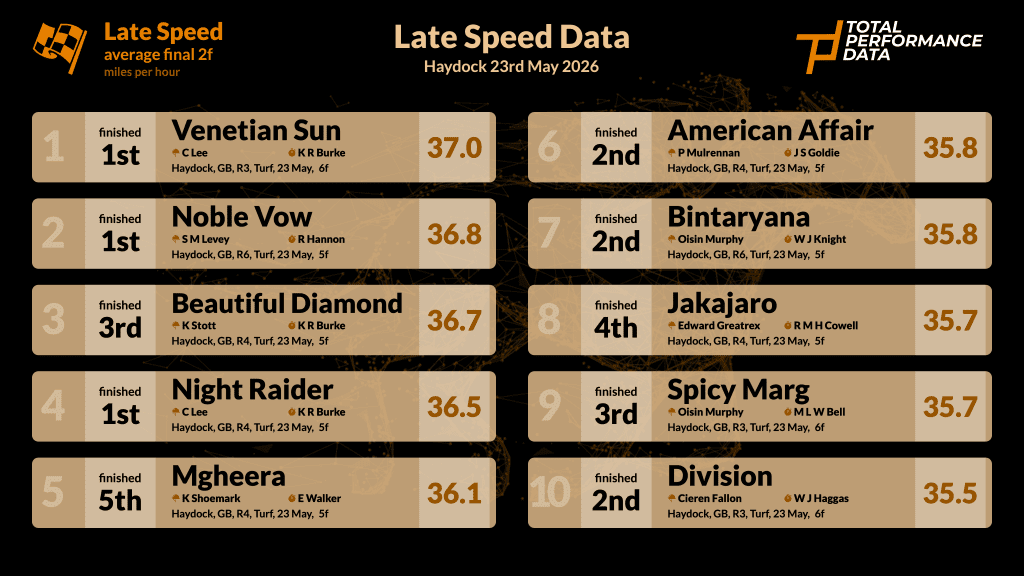
The vast majority of this field needs to be forgiven for one reason or another. Whether it’s a poor run last time out or whether it’s taking a view that the return to sprinting will be the key, I found it relatively easy to make a case against plenty of this field running a bad race, but the exception to that is Venetian Sun. Karl Burke’s filly has won 5 of her 7 starts and her only defeats have come behind Precise in the Moyglare and then in the 1,000 Guineas at Newmarket where she clearly didn’t stay. The data comparison above comes from “that” meeting at Haydock Park in May, but amongst all the controversy that day, there was a superb performance from Venetian Sun, who ran out a 3 length winner of the Sandy Lane Stakes under Clifford Lee, recording the fastest late speed figure of the meeting in the process. Her final furlong time of 12.66s was half a second faster than anything else and she was the only horse in either the Sandy Lane Stakes or the Temple Stakes (won by Night Raider) to record a late speed figure of 37 mph or above. There are absolutely no doubts about the track either given that she won the Albany Stakes at the Royal meeting last year, another race where she ran the fastest final furlong (12.92s) and that contest has produced 5 subsequent pattern winners. She has clearly changed a lot in the last 12 months, but her stride data from the Albany Stakes (23.8 ft average stride length, 2.44 average strides per second) are both above the average figures recorded for a winner at this level over the course and distance. In a race where it would be tempting to go searching for a horse that will improve because they are running in a sprint over 6 furlongs, there is the opportunity to back a course and distance winner who arrives in winning form and who is unbeaten over the trip. The case for Venetian Sun is certainly the strongest from the data we have.