



Sauren Dachfonds Preis (ex Gerling-Preis) (G2)
Cologne - 8th May 2026
There can be no question that jockeys are brave. To even get on a horse and race ride takes courage, but once a race is underway there are so many split second decisions that need to be made, all with 400 kilos of thoroughbred racehorse underneath. Tactical rides are superb when they work, but when they don’t, it can be a difficult time to be a jockey. When the gaps don’t come, when a horse is ridden with too much early aggression or when a horse is simply given too much to do and finishes quickly without quite getting there, the criticism will flow. All of that happens on a very regular basis and with so many variables in a race, it must be an almost impossible task. However, when it goes right, as it did for Sibylle Vogt aboard ALLENO in this years Sauren Dachfonds Preis at Cologne on Friday, it serves to show that the jockeys at the top of the sport are some of the world’s leading sports professionals.
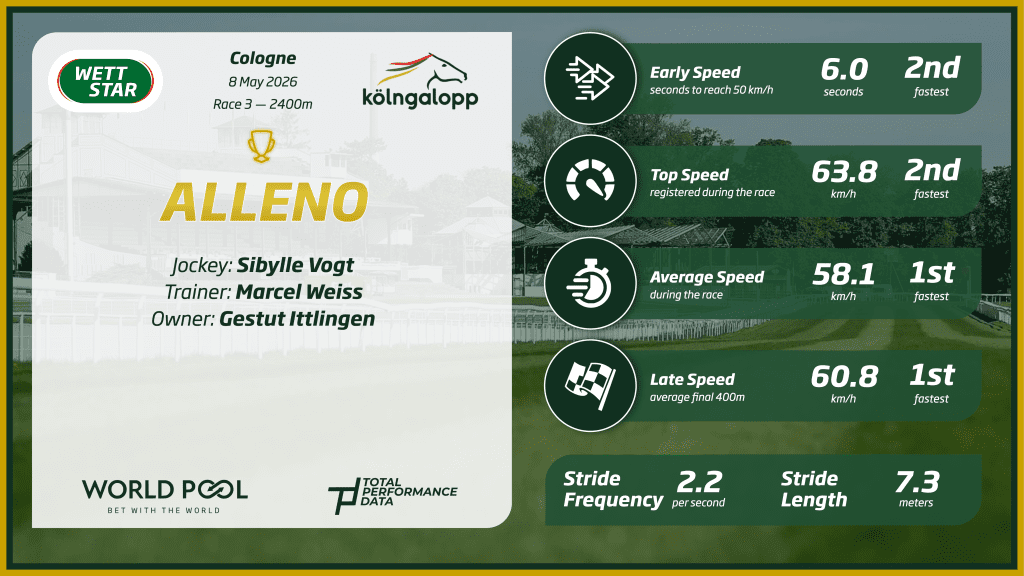
Alleno was winning this race for the 2nd year in a row, but the 5-year-old son of Nathaniel appeared to run close to a career best as he ran out a very comfortable 5 length winner. He had form in G1 company behind the likes of Sibayan and Goliath last Summer and certainly deserved his place towards the head of the market. Having sat behind the pace, it would have been very easy for Sibylle Vogt to attempt to force her way out and make her challenge on the left hand side of the leader. Instead, she chose to sit still around the turn and waited for the leader (Zuckerhut) to drift to his left and thus open a gap on the inside rail. That gap eventually came with 400m to run and when it did, Alleno had both the tactical speed and the ability to lengthen his stride to go through it. A late speed figure of 60.8 km/h ranked 1st in the field and made him the only horse to clear 60 km/h for that metric as he clocked the fastest time for each of the final 3 furlong splits. His stride length, which reached a race peak average of 7.59 m was considerably longer than the runner-up (Wintertraum) who ran a fine race in defeat for Waldemar Hickst and Rene Piechulek, but it was obvious with a quarter of a mile to run that Alleno was going to win and win well. He is perfectly suited to the track at Cologne. Our pre-race expected data showed that the average winner of this race could be expected to record an average stride length of 7.1m at an average stride frequency of 2.23 strides per second. Alleno recorded an average stride length of 7.34m at an average of 2.22 strides per second. Compared to the 6.74 m average stride length of the runner-up at 2.41 strides per second, it serves as a good comparison and helps to explain why Alleno was able to pull clear in the closing stages. I accept that there is quite a considerable amount of after timing in that statement, but it’s “horses for courses” and Alleno is the horse for this race and the track in Cologne as a whole.
As I said at the start, if this hadn’t gone to plan, if the gap hadn’t appeared on the inside rail and Alleno had been forced to switch, he may not have been able to adjust his feet quickly enough to get himself out of trouble and we would now be talking about him as an unlucky loser who was ridden with too much luck in mind. Instead, Sibylle Vogt was able to rely on her experience and trust that her mount would find his way through the space on the inside of the leader when it came. He did and the pair went on to win this Group 2 with some ease.