



St James's Palace Stakes (G1)
Ascot - 17th June 2026
This race was billed as a match between the best of this year’s 3-year-old Colts and it turned out to be exactly that. Bow Echo and Gstaad are a pair of extraordinary talents and they served up one of the best renewals of the St James’s Palace Stakes that we have seen in recent years. Bow Echo came out on top and he has confirmed the strength of his 2,000 Guineas win at Newmarket to remain unbeaten, even if the winning margin has been significantly reduced. When they crossed the finishing line in front of the packed stands at Ascot, there was just 0.02s between the pair. Rather interestingly, there was just 0.01s between the pair when they passed the 2 furlong pole and as a result, both sets of connections can take some encouragement from the way this race has panned out.
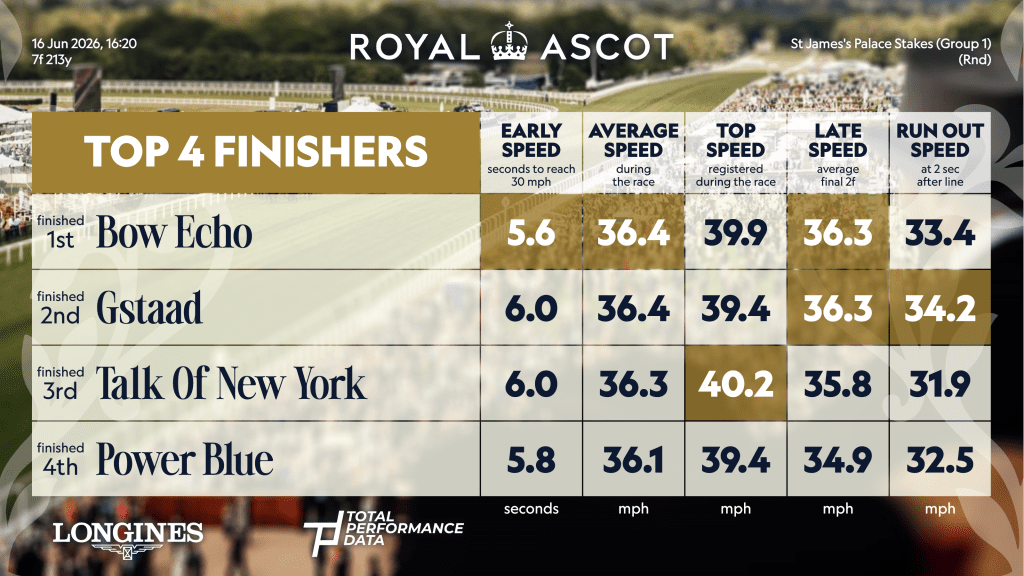
I will add a small note on Talk of New York, who as you can see from the graphic above recorded the fastest top speed figure in the field. He ran a fine race and briefly threatened as they turned for home, but his stride frequency dropped considerably into the final furlong and whilst he is a very good horse, he had the mis-fortune of meeting a pair of exceptional colts on Tuesday afternoon and he has ultimately been found wanting. There will be other opportunities for him and it’s not impossible to think that he may yet be competitive in Group 1 company by dropping back to 7 furlongs, but I could find no reason from our data to suggest that he would be able to reverse the form.
Instead, it’s better to focus on the winner and runner-up. As they reached the 2 furlong pole, the pair moved into position and whilst visually Bow Echo was travelling best of all, Gstaad had actually been the faster of the pair over the 5th and 6th furlongs. Aidan O’Brien’s charge had the longer stride of the pair, recording a race average stride length of 24.14 ft, but he simply lacks the instant turn-of-foot that his main rival possesses at this stage. A race average stride frequency of 2.29 strides per second was the lowest of the 6 runners and that reached a peak average of 2.35 per second, another race low figure and the smallest variance between average and peak in the field. It’s a small point, but given the way this race panned out, the bend may well have worked against Gstaad who took longer to reach top speed. Once getting his run through on the rail, he rallied well and ran the fastest closing split (12.63s) and went through the line with a run-out speed of 34.2 mph. It is very easy to say things in hindsight and I can’t prove my argument either way, but I do wonder if Gstaad would have had a better chance of beating Bow Echo had they raced on the straight course rather than round the bend. If we take the hypothesis that Aidan O’Brien’s horse needed the run at Newmarket, then this longer striding horse may be better suited to a race that develops earlier where he is less vulnerable to Bow Echo’s turn-of-foot. It’s little more than a hypothesis at this stage, but Gstaad did have a higher top speed figure (40.72 mph) than Bow Echo at Newmarket and has recorded a longer average stride length in both races, so it is also not entirely without some merit in the data.
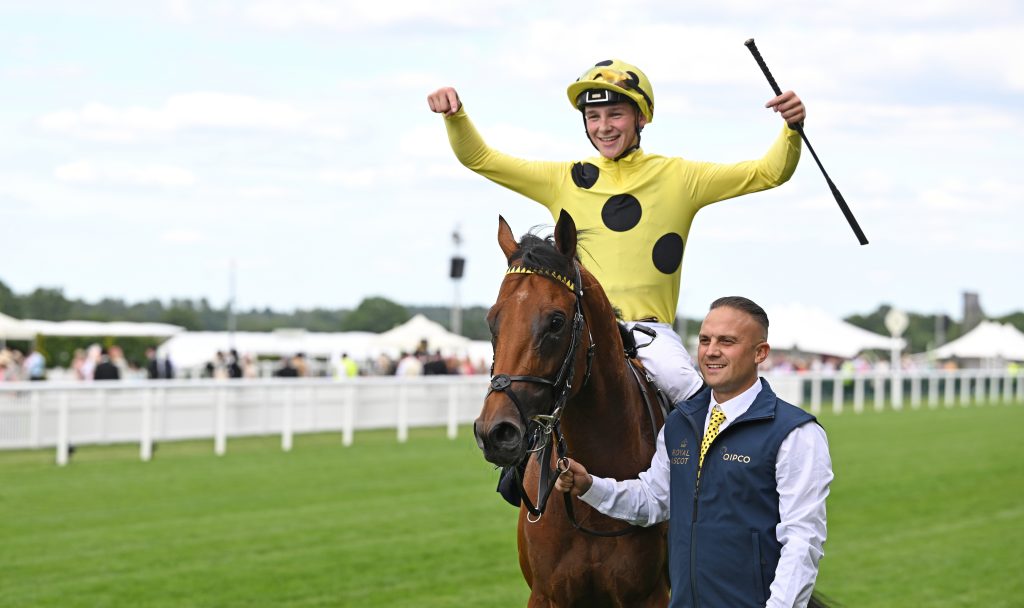
That case has merit, but the facts remain that Bow Echo has beaten him twice and they were both race fit this time. A finishing speed of 100.5% from the winner and a winning time of 1:38.48, which was 0.14s outside the TPD Expected time for the race on “Good to Firm” ground both point to this being run at a fair and even tempo and as such, the winner needs to emerge with some credit given that he had to come wider than the runner-up around the bend. He was bumped at the start after some early battling for racing room, an incident which the Stewards deemed enough to give Ryan Moore a 3 day ban for careless riding, Bow Echo did eventually settle behind the early pace. Having been in his riders hands at the 2 furlong pole, it appeared that Bow Echo would clear away as the pace lifted but whilst his stride frequency did reach a race peak average of 2.46 per second in the penultimate furlong, he couldn’t sustain the effort and was left slightly vulnerable in the final furlong. Having taken 0.19s out of Gstaad in furlong 7, he duly gave back 0.16s of that in the final split and was slightly fortunate to hold on given the pair recorded identical late speed figures. His turn-of-foot was enough to get him to the front and I have no doubt that he is the faster of the pair over a short distance, but having been going so well, perhaps he was committed for home slightly earlier than was needed, as Billy Loughnane appeared to suggest in his post-race interviews.
Bow Echo remains unbeaten and whilst a case could be made for Gstaad reversing this form, a case could be made with equal measure that on another day Bow Echo might have sprinted clear of him. Frankel was unbeaten at this stage of his career too. Before the social media pile on begins, I want to make clear that I do not think that Bow Echo is Frankel 2.0. However, much like Frankel he found a way to win the St James’s Palace when neither horse nor rider were seen to their best effect. If this race was run over the same course and distance tomorrow, I am sure Bow Echo would be played later and in that scenario I’d be confident that he would win by further. He is the fastest of the 3-year-old milers and it’s important to remember that this was only his 5th start on a racecourse. He heads to the Sussex Stakes next and the track at Goodwood should play to his strengths. He isn’t Frankel, but he’s still an exceptional racehorse. If Newmarket was a Champions League performance, then this was the proverbial 1-0 on a wet February evening away at Stoke, but the history books will simply remember the form figures 1,1.