



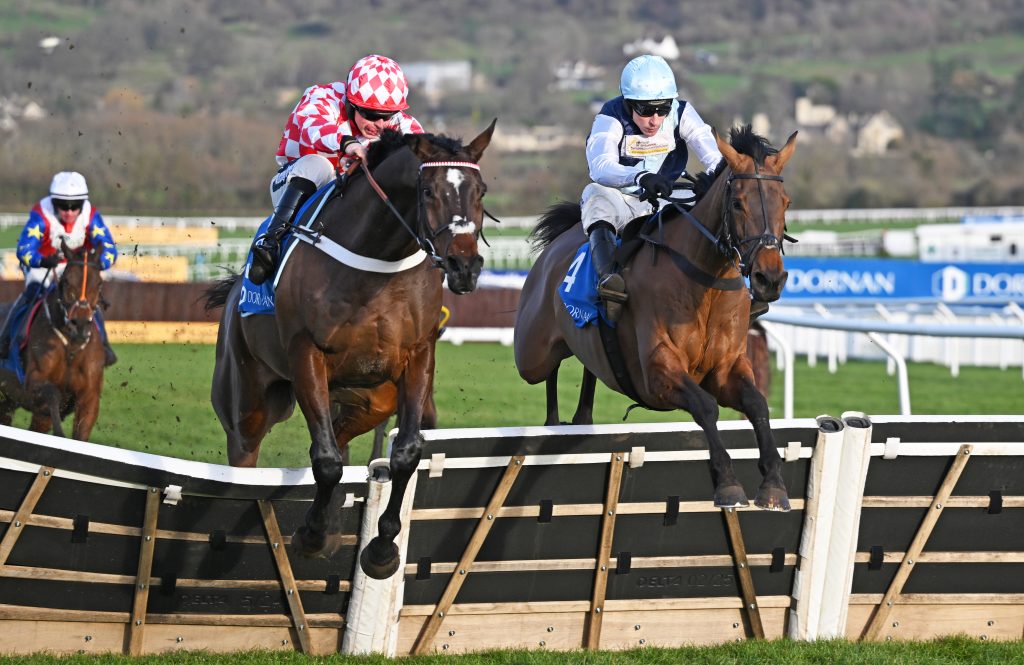
I’ll start with some of the basic conclusions that we can draw from the data. Since moving to Dan Skelton, Kabral du Mathan has definitely improved. The form of his 12 length romp at Haydock took a significant boost when the runner-up, Andashan, won comfortably on his next start at Newbury over Christmas. Kabral du Mathan was the fastest horse in each of the last 4 furlong splits (13.19, 12.27, 12.47 and 13.57s) to win with ease, recording race best top speed and run-out speed figures. That run came following wind surgery, but I think it’s important to note that despite having weight to concede, he beat horses with official ratings of 125 and 127 at the time. However, he took a significant step forwards when winning the Grade 2 Relkeel Hurdle at Cheltenham on New Year’s Day and that is the piece of form that we are best judging him on.
The ground was an important factor and a winning time of 4:52.82s, the fastest winning time in the race since Karabak in 2010 does point to the fact that it was “Good” ground. We can check that to a point and his time being 6.39s faster than the TPD expected time for the course and distance with that going description does suggest that Kabral du Mathan was able to run such a time at least in part because the course conditions allowed him to. Kabral du Mathan traveled extremely strongly and could be called the winner from a long way out, but having run the fastest final 3 furlong splits (12.77, 12.82 and 13.94s) I think it’s important to add some context to those closing furlongs too. Those finishing speeds, which led to a late speed figure of 33.4 mph, made Kabral du Mathan the fastest horse in the latter stages of the 4 races run on the hurdles course that afternoon, including the Listed “Junior” Bumper at the end of the card. If he is to be a contender in Grade 1 company then we might expect him to produce such a result, but in a race run with a finishing speed of 111%, it’s perhaps not a surprise to see that the horse with the best late turn-of-foot came out on top. A much better question to ask about Kabral du Mathan, is will he stay?
The simple answer is we don’t know. Firstly, he is yet to race beyond 2 miles and 4 furlongs and his run in the Relkeel was the first time that he had gone beyond 2 miles. When he was beaten last season, it came in races where the pace was stronger, most notably when Fiercely Proud beat him at Ascot in a race run with a finishing speed of 98%. He’s a much better horse now and having raced 8 times, winning 5 and never finishing outside of the first 2, he’s certainly going the right way. However, we cannot be certain that he will stay the 3 mile trip in the Stayers’ Hurdle. Both successes this season have come in races where the finishing speed was above 110% and in a Grade 1 at the Cheltenham Festival, that seems unlikely, although the 2 most recent renewals have recorded figures of 108 and 109% respectively.
It’s a better race this year and with JP McManus having such a strong hand with 2 horses who will almost certainly want this to be a stamina sapping contest, the percentage call is to expect a faster early pace and a more relentless gallop. That will test Kabral du Mathan if this is indeed the route he takes. His stride frequency data would suggest that he had more in the tank if needed on New Year’s Day, but getting the better of the 144 rated Jingko Blue and Lucky Place is some distance behind the form of the Christmas Hurdle and the Long Walk at Ascot. Lucky Place ran the fastest final 2 furlongs in the race when winning the Relkeel Hurdle last year, but this season he was 1.31s slower than Kabral du Mathan despite the 2 races having similar finishing speed percentages. It’s possible to take the view that Kabral du Mathan was simply a better horse, but it does raise slight questions over the form, especially on that unseasonably quick ground.