



Visit Qatar Sussex Stakes (G1)
Goodwood - 29th July 2026
“If we were to design a 3-year-old miler to win a Group 1 race, he would appear to have all the attributes and in-race metrics that you could ever want to see”.
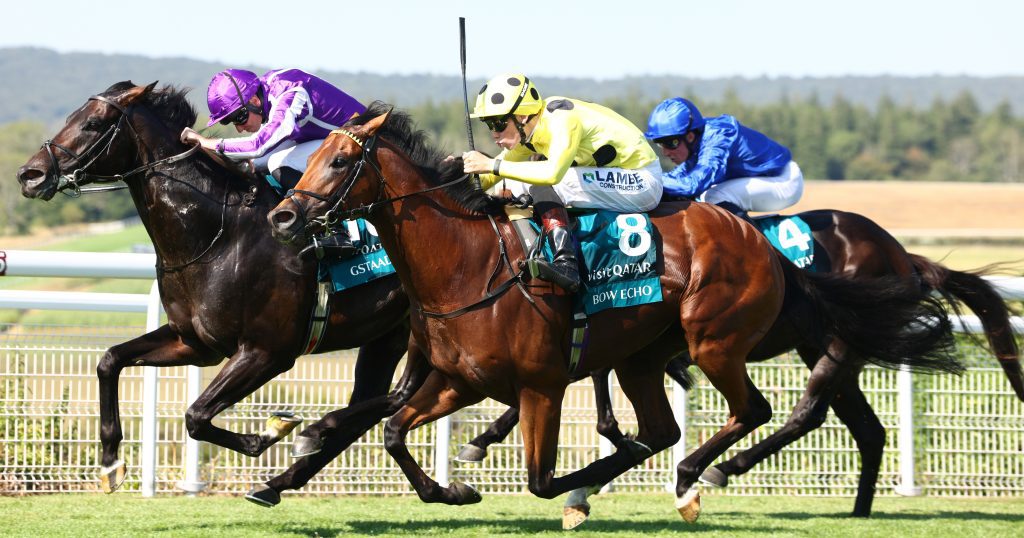
For the second time in the space of a few days I am writing about a Group 1 race that delivered on the potential that had been on show at the final declaration stage. Much like the King George VI and Queen Elizabeth Stakes at Ascot on Saturday, Wednesday’s Sussex Stakes produced a thrilling race on the South Downs as all the major players had their chance in the Goodwood straight. The market had the race between the first 3 horses to cross the line, but we shouldn’t lose sight of the fact that the Queen Anne winner was 4th and there were previous Group 1 winners in 5th, 6th, 8th, 9th and 11th. As a result, this was probably the strongest renewal of the Sussex Stakes in over a decade. At the head of all of the quality on show was BOW ECHO, the new star of the European Racing scene, who ran a winning time of 1:36.03 that has only been surpassed once this century (Notable Speech 2024). On the rare occasion that a 3-year-old gets to this stage of the season with an unbeaten record, the inevitable comparisons with Frankel will start to appear. Bow Echo is not Frankel. There are some clear comparisons to be made between their form, a stunning Guineas victory at Newmarket, a far from fluent display in the St James’s Palace Stakes and then a wonderful performance to dominate the older horses in the Sussex Stakes. However, there isn’t any need to make such a comparison because Bow Echo is a superstar in his own right.
This wasn’t an easy watch for his supporters. In a far from ideal position in the middle of the pack at halfway, with Puerto Rico once again being ridden to keep him honest, Bow Echo had to fight for every yard of racing room and had to concede the first run to both Gstaad and Opera Ballo in the home straight. He had half a second to make with Opera Ballo as they passed the 2 furlong pole and that gap had only narrowed to 0.29s a furlong later, but the final furlong was the key point in the race and it is his late speed that separates Bow Echo from the crowd. A race best late speed figure of 38.14 mph was obvious to anyone watching, but a run-out speed of 35.18 mph, more than 4% faster than Gstaad, may not have been so obvious and would point to Bow Echo having more left in the tank had it been required. I don’t want to detract from the performance of Gstaad either. He has run another fine race and in a “normal” year, we may well be waxing lyrical about him. He ran a time of 1:36.12, which would have been fast enough to win all but 3 of the Sussex Stakes run this century and having had an easier passage through than the winner did, I don’t think his connections can have any real complaints about the outcome. They are a pair of exceptional 3-year-old colts and there is the distinct possibility that there may be yet more to come, especially if Gstaad steps up to 10 furlongs which his long stride would suggest is within his reach. They were getting 8 lbs from Opera Ballo and as a result, Charlie Appleby’s horse technically comes out best at the weights. Things didn’t go perfectly for William Buick and Opera Ballo was lit up when the stalls opened, but he continues to struggle to relax in the way that the 3-year-olds do and if the gap in the weights was narrowed, I’d still be of the opinion that Bow Echo would still prove to be too strong.
Bow Echo’s average stride length (25.71 ft) ranked 2nd and it reached a peak of 27.99 ft, shorter than Gstaad (28.15 ft). Exceptional horses can lengthen their stride like this, with Bow Echo finding an extra 9% from average to peak, but it is their ability to conserve their energy in the middle of the race that sets them apart. The stride frequency figures tell a crucial tale. With such a long stride, it is no surprise to see that Bow Echo (2.22) and Gstaad (2.27) rank towards the lower end of the field for that metric, but Bow Echo’s minimum stride frequency figure was 11th of 12 and it is that ability to relax that has stood him in such good stead. He conserves energy perfectly and is then able to unleash his turn-of-foot at the end of his races, as he did when recording a race best time of 12.02s for the final furlong.
Bow Echo is unbeaten and is one of a pair of exceptional 3-year-old colts that can now be considered to be the best milers around. He’s beaten the older horses and if he continues to improve, as he may well be expected to after just 6 starts, then it seems highly likely that he will continue to confirm that dominance. He’s not better than Frankel, but I believe that he is the best 3-year-old miler that we have seen since Sir Henry Cecil’s superstar. Our data does nothing but support that theory and if we were to design a 3-year-old miler to win a Group 1 race, he would appear to have all the attributes and in-race metrics that you could ever want to see.